


Rumors of a $200 Social Security boost in 2026 have spread rapidly across social media and online news platforms, raising hopes among millions of retirees and disability beneficiaries. Yet federal officials and policy analysts say no such increase has been enacted, and the only confirmed change for next year remains the routine cost-of-living adjustment tied to inflation.
Table of Contents
$200 Social Security Boost in 2026
| Key Fact | Detail |
|---|---|
| Confirmed increase | 2026 benefits will rise via annual COLA |
| $200 boost status | Proposed legislation only, not law |
| Payment certainty | No guaranteed supplemental payment |
| Policy concern | Trust fund solvency remains unresolved |
For now, the $200 Social Security boost in 2026 remains a political proposal rather than a policy reality. Unless Congress acts, beneficiaries will continue to receive only the standard inflation-linked adjustment. As lawmakers debate long-term reforms, retirees are left balancing rising costs against a system designed to change slowly and deliberately.
What Is Officially Confirmed for Social Security in 2026
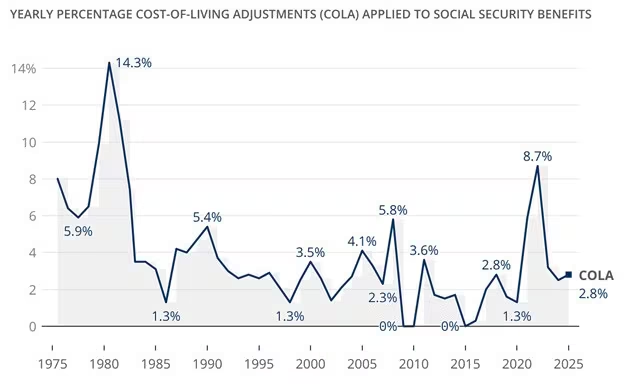
The Social Security Administration (SSA) has confirmed that beneficiaries will receive an annual cost-of-living adjustment (COLA) beginning in January 2026. The increase is automatic under federal law and applies to retirement, survivor, and disability benefits, as well as Supplemental Security Income.
The COLA is calculated using inflation data from the Consumer Price Index for Urban Wage Earners and Clerical Workers. When consumer prices rise, benefits adjust upward to help preserve purchasing power.
However, the increase is percentage-based, not a flat dollar amount. That means beneficiaries with higher base payments receive larger increases in dollar terms, while those with smaller benefits see more modest changes.
“The COLA is designed as a protection against inflation, not as an income enhancement,” the SSA has explained in its annual guidance to beneficiaries.
Where the $200 Social Security Boost Claim Originated
The idea of a $200 Social Security boost in 2026 traces back to legislation introduced in Congress during recent inflation spikes. Several Democratic lawmakers proposed bills aimed at providing temporary relief to seniors and low-income beneficiaries facing sharply rising costs for housing, food, and healthcare.
One prominent proposal would provide an extra $200 per month for a limited period, in addition to existing benefits. Similar measures were introduced during earlier economic disruptions, including the COVID-19 pandemic and prior inflation surges.
“These proposals reflect genuine concern about affordability, especially for older Americans living on fixed incomes,” said a retirement policy analyst who has reviewed the legislation. “But they are not the same as enacted benefits.”
To date, none of these proposals have cleared both chambers of Congress.
Why the Proposal Has Not Advanced
Passing changes to Social Security benefits requires navigating one of the most politically sensitive areas of U.S. fiscal policy. Lawmakers must balance immediate financial relief with the long-term stability of the program.
According to the Congressional Budget Office (CBO), the Social Security trust funds are projected to face funding shortfalls in the coming decade. Without legislative changes, benefits could eventually be reduced once reserves are depleted.
Temporary benefit boosts raise concerns because they increase payouts without necessarily addressing revenue. Fiscal conservatives argue this worsens long-term imbalances, while supporters counter that emergency relief is justified during periods of economic stress.
“Any increase, even temporary, has ripple effects,” said an economist specializing in entitlement programs. “Congress is wary of setting precedents that expand benefits without funding mechanisms.”
Historical Context: Have Emergency Boosts Happened Before?
While a flat $200 monthly increase would be unprecedented, Congress has intervened in other ways during economic crises.
During the COVID-19 pandemic, lawmakers approved stimulus payments that included Social Security beneficiaries. However, those payments were issued through the Treasury, not as changes to Social Security benefits themselves.
In contrast, COLA increases have occurred annually since the 1970s, becoming a predictable component of retirement planning. Emergency proposals, by comparison, have historically struggled to gain bipartisan support.
This distinction is often lost in online discussions, where one-time relief payments are conflated with permanent benefit changes.
Why COLA Often Feels Insufficient to Beneficiaries
Despite annual adjustments, many retirees report that COLA increases fail to keep pace with their real-world expenses. Economists note that seniors spend disproportionately on healthcare, housing, and utilities—categories that often rise faster than general inflation.
The Consumer Price Index used for COLA calculations reflects spending patterns of working households, not retirees. As a result, benefit increases may not fully offset cost pressures faced by older Americans.
This gap helps explain why proposals like the $200 boost resonate with the public, even if they remain politically uncertain.
How Misinformation Spread So Quickly
The claim gained momentum through headlines and social media posts that framed the proposal as a certainty rather than a possibility. Some articles failed to clarify that the legislation had not passed, while others recycled outdated information.
Fact-checking organizations have repeatedly noted that the SSA has issued no announcement supporting claims of a guaranteed $200 increase.
“The speed of misinformation often outpaces official clarification,” said a media literacy researcher. “People tend to share good news quickly, especially when it concerns financial relief.”
What Different Beneficiaries Would Receive If It Passed
If a $200 monthly boost were enacted, it would have different impacts depending on income level and benefit type.
For recipients relying almost entirely on Social Security, the increase would represent a substantial percentage gain. For higher-income retirees, it would be less transformative but still meaningful.
However, analysts stress that until legislation is passed and funded, such projections remain hypothetical.
Political Outlook: What Happens Next
With inflation moderating, momentum behind emergency benefit increases has slowed. Lawmakers are increasingly focused on broader Social Security reform, including payroll tax adjustments and benefit formulas.
Some policy experts believe targeted relief for low-income beneficiaries is more politically viable than universal increases.
“Future proposals are likely to be narrower,” said a former congressional staffer. “Broad, flat increases face steep odds in the current fiscal environment.”
What Beneficiaries Should Do Now
Experts recommend that beneficiaries plan based on confirmed policy, not proposed legislation. Official SSA notices, mailed annually and published online, remain the most reliable source of benefit information.
Financial planners also advise retirees to budget conservatively and consider healthcare costs, which often rise faster than benefits.
FAQs About $200 Social Security Boost in 2026
Is the $200 Social Security boost in 2026 guaranteed?
No. It remains a proposal and has not been enacted into law.
Will COLA increases continue every year?
COLAs depend on inflation and are not guaranteed if prices remain flat or decline.
Could Congress approve a smaller boost instead?
Possibly, though no legislation has advanced far enough to confirm details.
How can beneficiaries verify claims?
By consulting the Social Security Administration’s official website or direct correspondence.