

Oldest River on Earth Is in Australia: The Finke River, known by its traditional name Larapinta, has recently been confirmed by geologists as the oldest continuously flowing river system on Earth — predating the Nile, Amazon, Mississippi, and even the formation of many major mountain ranges. This ancient waterway runs through central Australia, and while it may appear dry and unassuming most of the year, it holds secrets that stretch back over 300 to 400 million years — long before the age of dinosaurs, and even before Pangaea fully formed. That’s not just ancient — that’s prehistoric on steroids. This article will walk you through everything you need to know about the Finke River — from its geological evidence, Indigenous significance, and ecological role, to how it’s still shaping Australia’s desert landscapes today.
Table of Contents
Oldest River on Earth Is in Australia
The Finke River — or Larapinta — is more than a geographical feature. It’s a living testament to Earth’s ancient history, a sacred site for its Traditional Owners, and a resilient ecosystem in one of the harshest environments on Earth. Older than dinosaurs, untouched by glaciers, and still shaping the land it crosses, the Finke is a reminder that the world is far older and wilder than we often give it credit for. As we face climate change and environmental uncertainty, the story of the Finke tells us this: nature is resilient, deep-rooted, and worthy of our utmost respect — especially the quiet parts we overlook.
| Aspect | Details |
|---|---|
| Official Name | Finke River (Indigenous name: Larapinta) |
| Estimated Age | ~300–400+ million years |
| Location | Northern Territory & South Australia, Australia |
| Length | 640–750 km (~400–470+ miles) |
| River Type | Intermittent (mostly dry, flows only after rain) |
| Unique Feature | Cuts through mountain ranges older than itself |
| Geological Age | Formed before or during the Devonian Period |
| Cultural Importance | Sacred in Arrernte Aboriginal Dreamtime |
| Associated Park | Finke Gorge National Park |
| Official Reference | Britannica |
What Makes the Finke River So Special?
The Finke River doesn’t look like the mighty Nile or the Amazon. In fact, if you saw it during a dry spell (which is most of the time), you might just see a sandy, dusty riverbed with scattered waterholes. But don’t be fooled.
Despite its quiet surface, this river tells a story that’s louder than roaring waterfalls — a story written in stone, older than dinosaurs, and untouched by glacial reshaping or modern tectonics.
The MacDonnell Ranges, where the river begins, formed around 300–400 million years ago. But the river’s channel cuts through them, not around them — a big hint that it was already flowing before those mountains even existed. This rare geological condition is known as antecedence — and it’s the smoking gun proving the river’s incredible age.
How Do We Know the Oldest River on Earth Is in Australia?
Geologists rely on several tools to estimate the age of rivers, including:
Antecedence
This is a major clue. The Finke River slices right through the MacDonnell Ranges, which rose due to tectonic activity in the Paleozoic era. The river had to already be flowing when those mountains were pushed up — otherwise, it would’ve gone around them. Only a few rivers in the world, like parts of the Colorado River, show this feature — and none are as old as the Finke.
Stratigraphy and Radiometric Dating
Scientists analyze rock layers and isotopes in sediment deposits to understand when the land began forming — and how long erosion and water flow have occurred. In the Finke’s case, these studies date parts of the system to the Devonian Period (approx. 419 to 359 million years ago), suggesting a minimum age of around 300 million years.
Stable Continental Platform
Australia’s geological stability also plays a role. Unlike Europe or Asia, which have seen glaciers, mountains forming and eroding, and drastic climate changes, central Australia has stayed relatively unchanged. That preserved the Finke’s path for hundreds of millions of years.
Where Does the Finke River Flow?
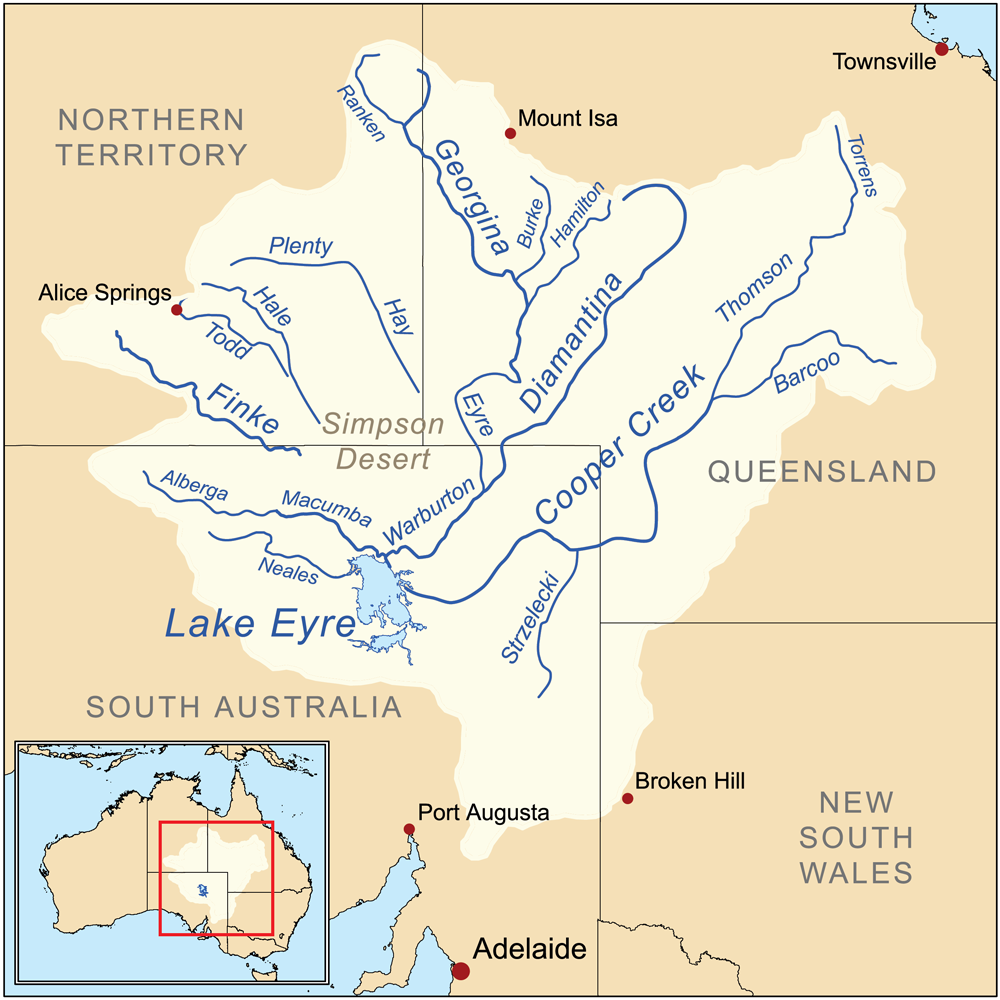
The Finke begins its journey in the MacDonnell Ranges near Alice Springs in the Northern Territory. It travels southeast, through Finke Gorge National Park, meandering across the arid desert before sometimes draining into the Macumba River and Lake Eyre in South Australia — if there’s been enough rainfall.
During dry periods, the river is mostly a string of disconnected waterholes like:
- Boggy Hole
- Glen Helen Gorge
- Ellery Creek Big Hole
But in rare flood years, these waterholes fill and connect, allowing the Finke to flow over vast distances.
Its episodic nature is another reason it’s been preserved for so long — with less erosion and sediment disruption than rivers that flow constantly.
Cultural Significance: The River as a Dreaming Track
The Arrernte people, the traditional custodians of the land around Alice Springs and the Finke, have deep spiritual connections to the river, which they call Larapinta.
In Aboriginal Dreamtime, Larapinta is not just a river — it’s a creation being, a path carved by ancestral spirits, connecting waterholes, mountains, and valleys. These stories aren’t just myths — they carry ecological knowledge, encoded over thousands of years.
To the Arrernte, certain sites along the river are:
- Ceremonial grounds
- Sacred women’s and men’s places
- Songlines linking ancestral stories across the continent
For thousands of years before European colonization, Aboriginal people used the Finke’s waterholes as lifelines for navigation, trade, survival, and ceremony.
Oldest River on Earth Is in Australia Role in Ecology and Climate
Despite being dry much of the year, the Finke River supports life in the desert — especially in its waterholes, which serve as biodiversity hotspots. Here’s what survives:
- Redgums and ghost gums, deep-rooted trees that tap into underground water
- Desert fish species like the spangled perch that can survive in isolated pools
- Birdlife, including species like the zebra finch and black kite
- Reptiles, like perentie lizards and sand goannas
Its most famous oasis is Palm Valley, located within Finke Gorge National Park, where Livistona mariae, a rare species of red cabbage palm, thrives. These palms are believed to be descendants from a wetter climate era, preserved only because the Finke’s underground water kept their habitat alive.
A Geological Survivor Through Mass Extinctions
Let this sink in: the Finke River has witnessed five major extinction events.
- It predates the extinction that wiped out 90% of marine life 250 million years ago.
- It was flowing when T. rex ruled the land.
- It watched the rise and fall of ice ages, and even modern humans.
It’s seen more planetary change than any structure built by humans.
The fact that its course remains mostly unchanged today makes it one of Earth’s longest-surviving natural features.
Real-World Lessons and Environmental Importance of the Oldest River on Earth
So why should we care about a dry river in the middle of nowhere? Well, aside from its epic story, the Finke teaches us a few things:
Environmental Resilience
It shows how nature survives and adapts through climate change, continental drift, and mass extinctions — without intervention.
Cultural Knowledge Preservation
The Dreamtime stories of the river offer models for living with the land, not against it — using water responsibly, respecting natural cycles, and understanding how landscapes change.
Sustainable Tourism and Conservation
Eco-tourism to places like Palm Valley and the Larapinta Trail brings in revenue and awareness, while also encouraging conservation of fragile desert ecosystems.
The Finke River in Modern Times
Today, the Finke remains:
- A popular destination for 4WD expeditions
- A highlight on the Larapinta Trail, one of Australia’s top long-distance hikes
- A source of fascination for earth scientists, geologists, and conservationists
It also hosts the Finke Desert Race, a high-adrenaline off-road event that brings global attention to the region each year.
Efforts are being made to protect its fragile landscape, both by local Indigenous rangers and national park authorities, to make sure this ancient river continues to whisper its secrets into the future.
What America’s First Flashing Yellow Arrow Signals Mean for Everyday Drivers
Scientists Stunned: Life Discovered Thriving in a Place Once Deemed Completely Impossible
What Antarctica Looked Like Before Ice — And the Civilization Some Scientists Are Questioning