

A study claiming Trees React to Solar Eclipses has triggered widespread scientific debate after researchers recorded synchronized electrical signals in a mountain forest in Italy. While the research team suggested trees responded hours before the celestial event, independent plant scientists say environmental electricity and weather conditions offer a far more likely explanation.
Table of Contents
Trees React to Solar Eclipses
| Key Fact | Detail |
|---|---|
| Location | Alpine spruce forest, Dolomite Mountains, Italy |
| Main Claim | Synchronized electrical activity recorded before eclipse |
| Scientific Response | Most biologists attribute signals to weather and atmospheric electricity |
Researchers worldwide are now preparing instruments for future eclipses to test the phenomenon again. Until repeated evidence appears, most scientists say the simpler explanation remains strongest: forests respond to their environment, not to celestial events yet to occur. As one ecologist summarized, “Nature is complex enough without giving plants foresight.”
Trees React to Solar Eclipses: What the Original Research Claimed
Researchers placed sensitive electrodes on several spruce trees in a remote alpine forest. The instruments measured bioelectrical fluctuations moving through roots and trunks — extremely small voltage changes common in living plants.
During a partial solar eclipse in October 2022, sensors recorded synchronized electrical activity across multiple trees. The signal appeared several hours before the eclipse darkened the sky.
The research team interpreted the pattern as coordinated behavior. They proposed the forest functioned as a networked biological system capable of internal signaling.
Their explanation drew on earlier ecological work suggesting forests are connected by underground fungal networks. Popular science often refers to this as the “wood-wide web,” a concept associated with plant cooperation and resource sharing.
Plants are known to transmit electrical impulses. Similar signals occur when a leaf is damaged, when roots detect drought, or when light levels change. The unusual aspect in this case was timing — the activity appeared before any visible change in sunlight.
Scientists Question the Interpretation
Lack of a Biological Mechanism
Independent botanists quickly challenged the conclusion. They stressed that biology depends on physical stimuli.
Plants react to:
- sunlight
- temperature
- humidity
- chemical signals
- mechanical damage
They do not react to future astronomical alignments.
“There is no known sensory system allowing plants to detect an eclipse before environmental change begins,” several plant ecologists said in public scientific commentary.
A solar eclipse produces darkness only during the event itself. Hours earlier, Earth’s environmental conditions remain normal.
Alternative Explanation: Weather and Electricity
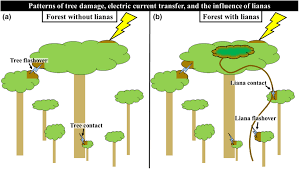
Critics pointed to atmospheric electricity as a far simpler explanation.
Forests interact continuously with electrical conditions in the air and soil. Trees conduct weak electrical currents because their tissues contain water and dissolved minerals.
Thunderstorms dramatically alter the electrical charge in the atmosphere. Lightning, ionization, and pressure changes can create synchronized electrical fluctuations across large areas.
Weather records indicated unstable atmospheric conditions occurred in the region earlier that day. Plant physiologists say such disturbances could easily cause coordinated signals in multiple trees simultaneously.
This explanation fits established research showing plants respond strongly to electrostatic changes and soil conductivity.
Why the Study Spread Quickly
The idea that Trees React to Solar Eclipses captured global attention because plant communication research is real and rapidly developing.
Over the last 25 years, scientists have confirmed trees exchange information using chemical and fungal pathways. A stressed tree can release airborne compounds warning nearby plants of insect attack. Neighboring plants then increase defensive chemicals.
Fungal networks also transfer nutrients between plants. Older trees sometimes supply sugars to seedlings growing in shade.
These discoveries reshaped ecological understanding of forests. However, researchers emphasize an important distinction:
Communication within an ecosystem is not prediction of an astronomical event.
Some scientists worried exaggerated interpretations could mislead the public and overshadow legitimate plant biology.
What We Know About Tree Signaling
Modern plant physiology identifies three major communication systems:
1. Chemical Signaling
Trees release volatile organic compounds into the air when damaged. Nearby plants detect the chemicals and prepare defensive responses.
2. Fungal Networks
Underground fungi connect plant roots. These networks transport nutrients and biochemical signals between species.
3. Electrical Signaling
Plants generate slow electrical pulses inside tissues. These signals help coordinate responses to environmental stress.
Electrical signaling is especially important. Plants use it to:
- close leaves during drought
- adjust water transport
- regulate photosynthesis
- respond to injury
However, these signals always follow a stimulus. Without environmental change, no electrical response is expected.
Solar Eclipses and the Natural World
Scientists have long documented how animals react to eclipses.
During eclipses:
- birds stop singing
- insects become quiet
- nocturnal animals emerge
- temperature drops several degrees
These responses occur because sunlight decreases rapidly. Animals interpret sudden darkness as evening.
Plants also respond during eclipses. Photosynthesis slows immediately as light fades. Leaves may change orientation and stomata can close.
But these reactions happen during the eclipse, not before it.
Astronomers note an eclipse produces no detectable environmental change hours earlier, meaning a biological anticipation mechanism would contradict current physics.
Historical Observations
Historical records show human fascination with eclipse behavior dates back centuries.
Chinese chronicles from over 2,000 years ago describe birds returning to nests during eclipses. European observers in the 1800s reported livestock settling down as if night had arrived.
Modern instruments confirm the same patterns. Weather stations regularly measure temperature drops and wind changes during eclipses.
None of these effects occur in advance.
How Scientists Test Extraordinary Claims
The debate highlights a core principle of science: reproducibility.
A single observation cannot establish a new biological capability. Researchers must repeat experiments under controlled conditions.
To validate the Trees React to Solar Eclipses hypothesis, scientists would need:
- Multiple eclipses
- Independent research teams
- Stable weather conditions
- Identical electrical signals
Without repeated results, researchers classify the observation as unexplained rather than confirmed.
Broader Scientific Implications
The discussion reaches beyond plant biology. It illustrates how easily data can be over-interpreted.
Complex systems often produce patterns that appear meaningful but result from coincidence. Researchers call this problem “signal versus noise.”
Environmental monitoring technology has become extremely sensitive. Instruments now detect tiny electrical variations previously impossible to measure. Scientists must determine which signals are biologically significant.
Many experts say the data remain valuable even if the interpretation changes. The measurements may help understand how forests respond to atmospheric electricity.
Environmental Monitoring and Future Research
The sensors used in the study belong to a growing field called bioelectrical ecology. Scientists are exploring whether forests can act as environmental monitoring systems.
Potential uses include:
- detecting drought stress
- monitoring ecosystem health
- predicting insect outbreaks
- measuring soil moisture changes
Researchers are planning future eclipse observations in different climates. Some teams want to place sensors in deserts, rainforests, and boreal forests to compare responses.
If no synchronized signal appears under stable weather, the eclipse hypothesis will weaken. If the pattern repeats, interest will increase significantly.
Public Interest and Scientific Communication
The controversy also reveals challenges in communicating science to the public.
Dramatic headlines often spread faster than cautious analysis. Scientists worry premature conclusions can reduce trust if later corrected.
Experts emphasize curiosity remains important. Unexpected observations frequently lead to real discoveries. Many major scientific advances began as puzzling anomalies.
However, researchers distinguish between interesting observation and confirmed explanation.
FAQs About Trees React to Solar Eclipses
Did trees react to the eclipse at all?
Yes. Plants respond to darkness and temperature drops during an eclipse because photosynthesis slows.
Do trees communicate?
Yes. Trees exchange chemical and fungal-network signals. This is well established.
Can trees predict astronomical events?
There is currently no scientific evidence supporting predictive behavior.
Is the original study wrong?
The measurements may be correct. Scientists dispute the interpretation, not necessarily the data.