

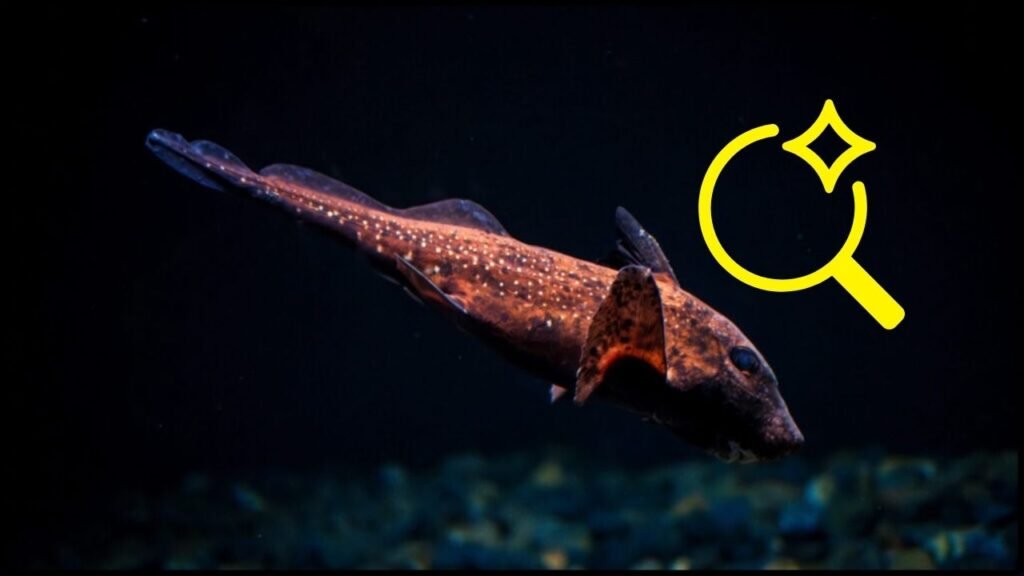
Strange Pacific Species With Unique Fangs: It’s not every day that a discovery shakes the very roots of what we thought we knew about evolution. But that’s exactly what happened when researchers identified a strange Pacific species with unique fangs — and not just any fangs, but real teeth growing right on the forehead of a deep-sea fish. We’re talking about the spotted ratfish (Hydrolagus colliei), an elusive, otherworldly creature that glides through the cold depths of the Pacific Ocean. This isn’t some tall tale from the docks or a scene from a fantasy movie. It’s real, peer-reviewed science that’s causing a stir in biology circles across the globe. And the reason is simple: this fish grows true teeth on its head — something scientists never thought possible.
Table of Contents
Strange Pacific Species With Unique Fangs
The discovery that the spotted ratfish grows real teeth on its forehead is more than a weird fact — it’s a humbling reminder that nature doesn’t follow our rules. She writes her own. From the deep Pacific to the bright labs of university campuses, this creature is sparking new research, inspiring future careers, and reshaping how we understand life itself. Next time you think you’ve seen it all, remember this little fish with forehead fangs — quietly swimming through the dark, holding a secret that could light the way for science’s next big leap.
| Feature | Details |
|---|---|
| Species Name | Spotted Ratfish (Hydrolagus colliei) |
| Habitat | Northeastern Pacific Ocean, from British Columbia to Baja California |
| Unique Feature | True teeth located on a forehead appendage called a “tenaculum” |
| Function | Used by males during mating to grasp females |
| Discovery By | Dr. Karly Cohen, University of Washington |
| Published In | PNAS – Proceedings of the National Academy of Sciences |
| Evolutionary Significance | First recorded case of true teeth outside the mouth in vertebrates |
| Conservation Status | Not endangered, but affected by bycatch |
| Career Connections | Marine biology, evolutionary science, anatomy, dental research |
| Official Article | Scientific American Coverage |
Getting to Know the Strange Pacific Species With Unique Fangs
Imagine cruising the ocean floor and coming across a creature that looks like a mix between a shark, a stingray, and something straight out of ancient legends. That’s the spotted ratfish. Belonging to a group called chimaeras, these animals are some of the oldest living relatives of sharks, having existed for more than 400 million years.
Chimaeras are sometimes nicknamed “ghost sharks”, thanks to their smooth, scaleless skin and haunting glides through deep waters. Most folks never see them — they live far below the waves, often between 200 and 900 feet deep, feeding on clams, worms, and crustaceans.
The spotted ratfish, found along the Pacific Coast from British Columbia down to Baja California, typically grows to around two feet in length. Its body is a shimmering bronze, speckled with silver-white spots that look like stardust. Its eyes shine bright green under light — not unlike the glow of a cat’s eyes at night.
What Are These Fangs on Its Forehead?
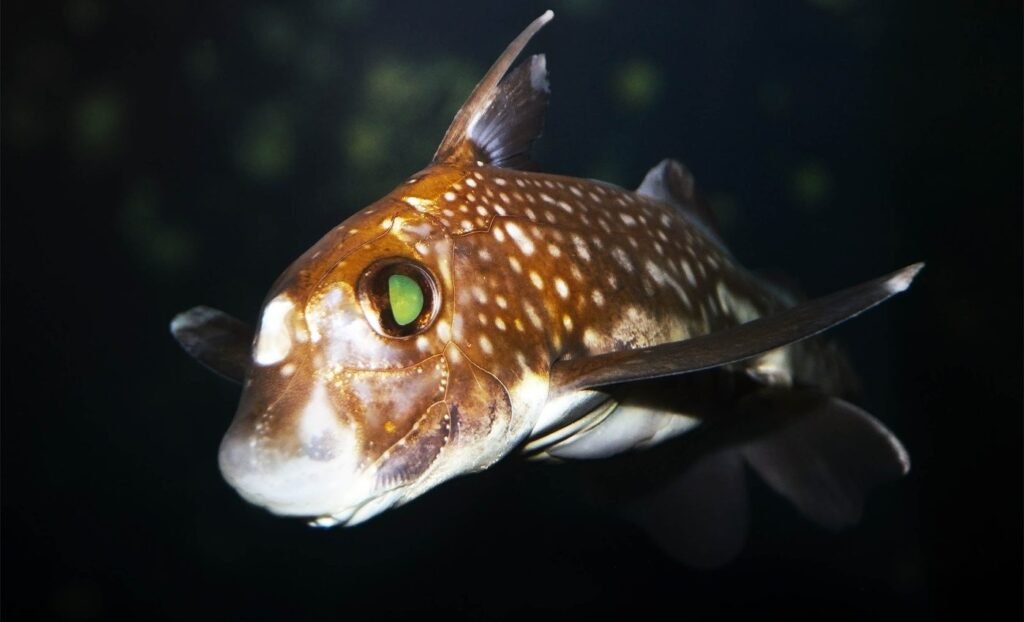
Now let’s talk about the main event — the fangs.
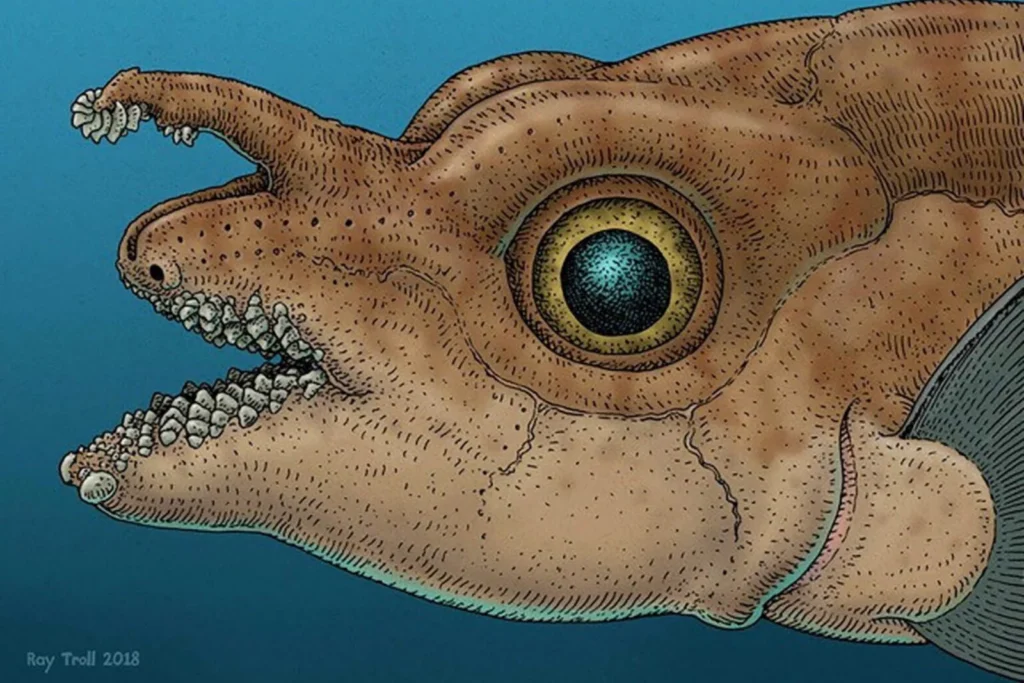
Male spotted ratfish have a special structure on their forehead called a tenaculum, which they only develop at maturity. During mating, the tenaculum extends forward like a grappling hook, helping the male hold onto the female.
What’s new — and utterly game-changing — is that the tenaculum isn’t just a hook. It’s lined with rows of real, functioning teeth.
And we’re not talking about rough patches of bone or denticles (like shark skin). These are true teeth — with enamel, dentin, and pulp, just like yours.
That’s never been seen before outside the mouth in any vertebrate — not in fish, reptiles, birds, or mammals.
How the Strange Pacific Species With Unique Fangs Discovery Was Made?
This eyebrow-raising find didn’t just happen by chance.
The research, led by Dr. Karly Cohen from the University of Washington, used advanced micro-CT scans, tissue sampling, and comparative anatomical studies to investigate the tenaculum of male spotted ratfish.
The goal was to determine whether the tenaculum’s structures were teeth in form only — or if they shared the same genetic and developmental blueprint as mouth teeth.
Turns out, they did.
Specifically, the forehead fangs were found to originate from dental lamina, a special tissue layer found only in the mouths of vertebrates — until now. This discovery shakes a long-standing evolutionary rule: that vertebrate teeth are exclusive to the oral cavity.
The study was published in PNAS and later picked up by Scientific American, which dubbed the finding “gloriously weird” — and rightfully so.
Why This Changes the Evolutionary Playbook?
Evolutionary biology has held, for decades, that teeth evolved only in the mouth, originating from the pharyngeal jaw area of early vertebrates. The idea that teeth could develop somewhere else — like on the head — just wasn’t considered plausible.
But the spotted ratfish just tore a page out of that rulebook.
The new understanding is that evolutionary potential is more flexible than scientists realized. Under the right conditions, the genetic programming for teeth can be reactivated or redirected elsewhere in the body.
This aligns with a broader scientific concept known as “deep homology” — the idea that different body parts across species (like wings, arms, or fins) can be built using similar ancient genetic toolkits.
The ratfish’s fanged tenaculum may be a living example of how structures once limited to one body region can re-evolve in new places when needed — a concept called co-option.
Practical Impact: Why This Matters Beyond the Ocean
To the average person, a fish with teeth on its head might seem like little more than a fun fact. But to scientists, doctors, and engineers, it offers huge insights.
1. Regenerative Medicine
Understanding how and where true teeth grow might help bioengineers find ways to regrow lost teeth or even stimulate new tissue growth for dental patients.
2. Evolutionary Insights
The find opens new possibilities for how ancient organs and systems might reappear in future generations, especially as species adapt to changing environments.
3. Fossil Interpretation
Fossils of extinct fish with mysterious head spines or bumps might now be reanalyzed under the lens of this new discovery. Were those just bones — or were they once functional teeth?
Native Knowledge: Listening to the Water
In many Indigenous traditions — including those of Native American coastal tribes — the ocean is not just a body of water; it is a living memory. It holds stories, teachings, and lessons — if we learn to listen.
The spotted ratfish, in all its mystery, might be viewed not just as a scientific specimen, but as a guardian of ancient knowledge. It teaches us that we have so much more to learn, not just about the sea, but about the land, the sky, and ourselves.
Sometimes, wisdom comes not from what we expect — but from what we nearly overlooked.
Careers Inspired by This Discovery
If stories like this spark your curiosity, you’re not alone. Discoveries like this one open the door to careers such as:
- Marine Biologist – Explore the mysteries of ocean life.
- Evolutionary Geneticist – Unlock the code of how species change.
- Anatomical Researcher – Map the body’s development from embryo to adult.
- Science Communicator – Share these amazing findings with the world.
Record-Breaking Ocean Drill Reaches Deep Mantle-Changed Rock Beneath the Atlantic
Oceans Set Another Heat Record for the Eighth Straight Year
Could Earth Bear Traces of Ancient Engineering? A Controversial Idea Emerges