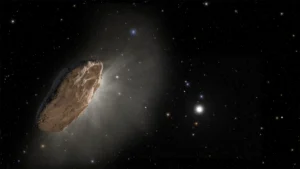

Space has a long history of surprising astronomers, but every so often a discovery appears that genuinely unsettles existing theories. Recently, researchers detected a distant object in our own galaxy producing rhythmic flashes of energy that behave more like a clock than a star. Unlike sudden cosmic explosions or irregular bursts from black holes, this source repeats its signal on a steady schedule. Each pulse arrives after a long silence, then fades again into darkness, only to return at the same interval.

The finding quickly gained attention because scientists have spent decades cataloging radio signals from the universe, and most follow predictable patterns. This one does not. It doesn’t spin quickly like a typical pulsar, nor does it resemble known binary star systems. Instead, it sits in an odd middle ground—too slow to fit old categories and too powerful to ignore. The discovery hints that something in the Milky Way is operating under physical conditions not fully understood.
The space object sending signals every 44 minutes has become a focus of intense observation and debate. Researchers confirmed the pulses appear in both radio waves and X-rays, meaning the energy source is extremely powerful. The timing is precise: roughly two minutes of activity followed by about 44 minutes of silence. That regularity strongly suggests a rotating astronomical body rather than a random cosmic flare.
Table of Contents
Space Object Sending Signals Every 44 Minutes
| Key Detail | Information |
|---|---|
| Object Name | ASKAP J1832-0911 |
| Location | Milky Way Galaxy |
| Distance from Earth | ~15,000–16,000 light-years |
| Signal Pattern | Every 44 minutes |
| Burst Duration | About 2 minutes |
| Detected Emissions | Radio waves and X-rays |
| Discovery Instrument | ASKAP radio telescope (Australia) |
| Confirmation | NASA’s Chandra X-ray Observatory |
| Classification | Long-period radio transient |
| Possible Explanations | Magnetar, white-dwarf binary, or new stellar object type |
What Exactly Was Discovered?
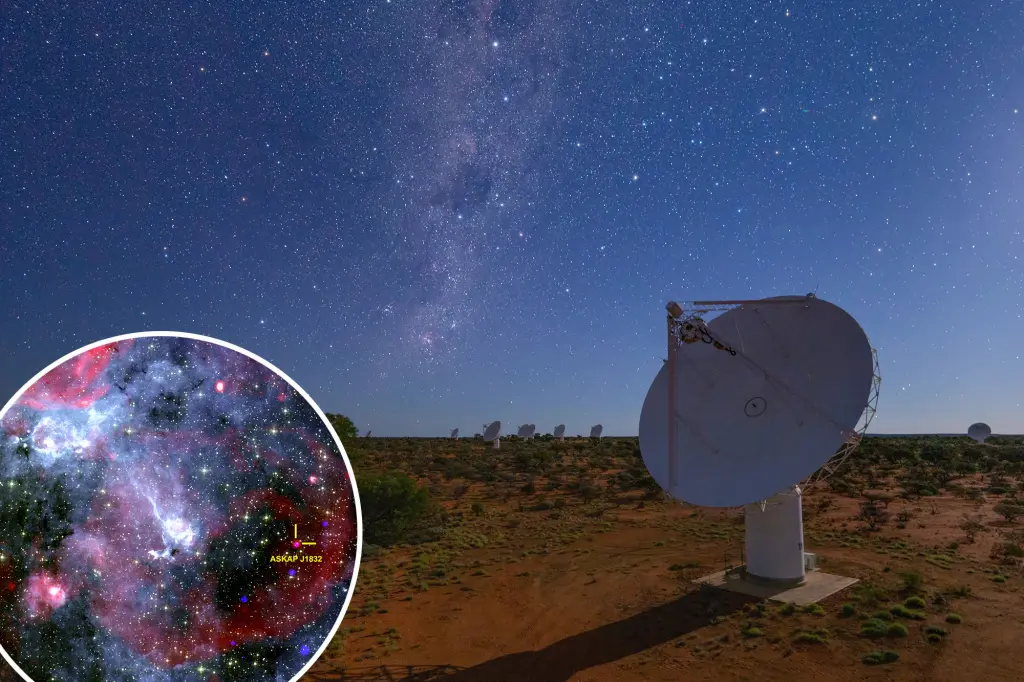
The mysterious object was first noticed by a radio telescope in Australia that continuously scans the sky for unusual signals. Astronomers identified a repeating radio flash coming from a region inside the Milky Way. At first, it seemed similar to pulsars—dense remains of dead stars known to emit beams of radiation.
However, something was off. Pulsars usually spin incredibly fast. Some rotate several times per second. This object, by contrast, took 44 minutes between pulses. That difference alone made researchers cautious about labeling it.
Further investigation deepened the mystery. NASA’s Chandra X-ray Observatory detected X-ray emissions occurring at the same time as the radio flashes. This combination is extremely rare. In most cases, long-period radio sources do not produce matching X-ray bursts. The object therefore didn’t fit into known categories of stellar remnants.
Scientists gave it the catalog name ASKAP J1832-0911 and classified it as a “long-period radio transient,” a term used for cosmic sources that brighten and dim over extended time intervals.
Why Scientists Are Confused
Astronomers rely heavily on comparison. When a new signal appears, they match it with known phenomena—pulsars, black holes, supernova remnants, or binary stars. ASKAP J1832-0911 refuses to match any of them cleanly.
The central problem is the timing. A neutron star spinning slowly enough to produce a 44-minute interval should not generate such strong radiation. Normally, slow rotation means weaker emission. Yet this object releases enough energy to be detected across thousands of light-years.
The second issue is the dual signal. Radio and X-ray bursts occurring simultaneously suggest intense magnetic activity. But the known objects capable of this behavior operate on much shorter timescales. The combination of long delay and high energy challenges existing astrophysical models.
In simple terms, the object behaves as if it follows rules astronomers haven’t fully written yet.
What Scientists Think It Might Be
A Magnetar
One of the strongest possibilities is a magnetar, a type of neutron star with a magnetic field trillions of times stronger than Earth’s. These stars are famous for twisting their own magnetic lines until they snap, releasing powerful radiation.
Researchers suspect the magnetar’s magnetic field could be storing energy and releasing it periodically. If the star rotates slowly while its magnetic poles sweep past Earth, the 44-minute pulses might be explained. Still, known magnetars usually rotate faster, so this explanation remains incomplete.
A White-Dwarf Binary System
Another theory involves two stars orbiting each other. In this scenario, a highly magnetized white dwarf interacts with a companion star. As the pair moves, magnetic fields accelerate particles, producing periodic radiation bursts.
This model can explain the regular timing but struggles to fully account for the X-ray strength. Scientists are still analyzing whether such a system could produce both types of emission simultaneously.
A Completely New Type of Object
The most exciting possibility is also the most uncertain: the object could represent a new class of stellar remnant. Astronomy has experienced similar moments before. Pulsars themselves were once mysterious repeating signals before being understood as rotating neutron stars.
If ASKAP J1832-0911 turns out to be something entirely new, it would expand knowledge of how stars evolve after death.
Why This Discovery Matters
At first glance, a distant signal might seem like a curiosity, but its implications are significant. Astrophysics depends on predictable relationships between mass, magnetism, and rotation. This object challenges those relationships.
Studying it could reveal:
- How magnetic fields behave in extreme environments
- How dead stars cool and age
- How energy is released in compact stellar remnants
It may also help explain other unexplained radio bursts observed across the sky. Some scientists suspect there are many similar objects waiting to be detected, simply overlooked because their pulses occur too slowly for traditional surveys.
In a broader sense, discoveries like this reshape our cosmic map. Each unexpected observation forces scientists to refine their understanding of matter and energy.
Important Clarification
Public excitement around repeating cosmic signals often leads to speculation about extraterrestrial intelligence. In this case, researchers emphasize that the signals are natural.
The pulses are not messages. They are electromagnetic radiation—energy beams sweeping through space as the object rotates. The regular timing is comparable to a lighthouse beam crossing a shoreline. When Earth lies in the beam’s path, telescopes detect a flash.
Astronomers routinely check for artificial patterns in such signals, but ASKAP J1832-0911 shows no characteristics of technology. Its emissions match extreme astrophysical processes rather than communication.
Conclusion
The discovery of a celestial source repeating every 44 minutes stands as one of the most intriguing recent observations in astronomy. It sits in our own galaxy yet behaves unlike familiar cosmic objects. The combination of slow timing, powerful radiation, and dual emission types makes it a puzzle scientists are eager to solve.
Whether it proves to be an unusual magnetar, a rare binary system, or a completely new type of stellar remnant, the object already serves an important purpose. It reminds researchers that the universe still holds surprises, even in regions we think we understand.
For now, telescopes around the world continue watching the same patch of sky, waiting for the next flash to arrive on schedule—another brief signal traveling 15,000 light-years just to reach Earth.