
Mystery of Egypt’s 27-Ton Black Sarcophagus: The Mystery of Egypt’s 27-Ton Black Sarcophagus captured worldwide attention when the massive stone coffin was discovered in 2018 beneath the busy streets of Alexandria, Egypt. When construction workers uncovered the enormous black granite box buried deep underground, speculation spread across news outlets and social media in the United States and around the globe. People wondered whether the sealed tomb might contain a legendary ruler, a forgotten treasure, or even the long-lost remains of Alexander the Great.
But when archaeologists finally opened the sarcophagus, the truth was far more grounded in science and history than mystery or myth. Instead of royal artifacts or a famous king, researchers discovered three skeletons submerged in a reddish liquid caused by centuries of sewage water seepage. While the find wasn’t a Hollywood-style treasure chest, it still provided archaeologists with valuable clues about ancient Egyptian burial customs, warfare, and everyday life during the Ptolemaic period. For historians, archaeologists, and anyone curious about the ancient world, this discovery highlights how modern science can unlock secrets that have remained hidden underground for thousands of years.
Table of Contents
Mystery of Egypt’s 27-Ton Black Sarcophagus
The Mystery of Egypt’s 27-Ton Black Sarcophagus reminds us that archaeology is often about uncovering knowledge rather than dramatic treasure. What began as a viral mystery turned into a meaningful scientific discovery that helps historians better understand life in ancient Alexandria during the Ptolemaic era. While the sarcophagus didn’t hold a legendary ruler, it revealed something just as important—the everyday realities of people who lived more than two thousand years ago. Through careful research and modern scientific techniques, archaeologists continue to piece together the story of human history one discovery at a time.
| Topic | Details |
|---|---|
| Discovery | Massive black granite sarcophagus discovered in Alexandria, Egypt in 2018 during construction. |
| Weight | Approximately 27 tons, making it one of the largest sarcophagi found in Alexandria. |
| Age | Estimated to date back 2,000–2,300 years to the Ptolemaic Period. |
| Contents | Remains of three individuals (two men and one woman). |
| Condition | Bodies decomposed due to sewage water leaking into the coffin. |
| Archaeological Importance | Provides insights into Ptolemaic burial practices and possible military history. |
| Official Source | Egyptian Ministry of Tourism and Antiquities – https://egymonuments.gov.eg |
The Discovery That Shocked the Archaeological World
In July 2018, workers digging a foundation for a new building in Alexandria, a historic port city along the Mediterranean coast, uncovered something unusual about 16 feet (5 meters) below ground level. As excavation continued, archaeologists realized the object was a giant granite sarcophagus sealed with mortar, suggesting it had never been opened since ancient times.
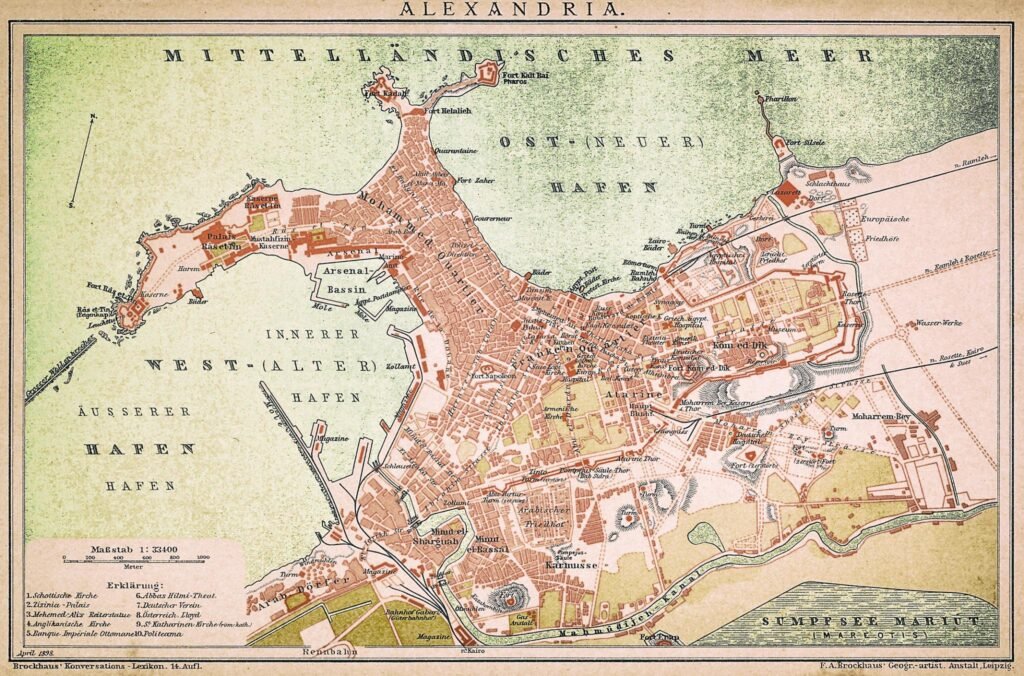
Alexandria itself is one of the most historically rich cities in the world. Founded by Alexander the Great in 331 BC, it quickly became a cultural and intellectual center of the ancient Mediterranean. The city once housed the famous Library of Alexandria, one of the largest knowledge centers in antiquity.
Because of this historical significance, the discovery of a massive sealed coffin in the city immediately sparked intense curiosity. Archaeologists suspected the sarcophagus might belong to an important figure from the Ptolemaic dynasty, which ruled Egypt after Alexander’s death.
Experts from the Egyptian Ministry of Antiquities quickly secured the site and began studying the coffin. The sheer size of the sarcophagus—nearly 9 feet long and carved from solid black granite—suggested that whoever was buried inside likely held an important position in society.
Why the Mystery of Egypt’s 27-Ton Black Sarcophagus Was So Unusual?
Ancient Egyptian sarcophagi were often decorated with hieroglyphs and carvings. However, this particular coffin was striking because of its plain design and massive weight.
Key physical characteristics included:
- Material: Solid black granite
- Length: About 2.7 meters (roughly 9 feet)
- Width: Approximately 1.5 meters
- Weight: Around 27 tons
- Sealed Lid: Estimated to weigh nearly 15 tons alone
Granite was one of the hardest stones used in ancient Egypt. Carving such a massive coffin required advanced tools and significant manpower. This alone indicates the individuals buried inside were likely people of status or importance.
Another surprising detail was the absence of inscriptions. Most Egyptian tombs contain hieroglyphs that identify the deceased and include prayers for the afterlife. The lack of markings on this sarcophagus made the discovery even more mysterious.
Researchers initially believed the coffin could contain a high-ranking military officer, noble, or government official from the Ptolemaic period.
Opening the Sarcophagus: What Archaeologists Actually Found
When the sarcophagus was opened under strict supervision by Egypt’s antiquities authorities, scientists encountered an unexpected and unpleasant surprise.
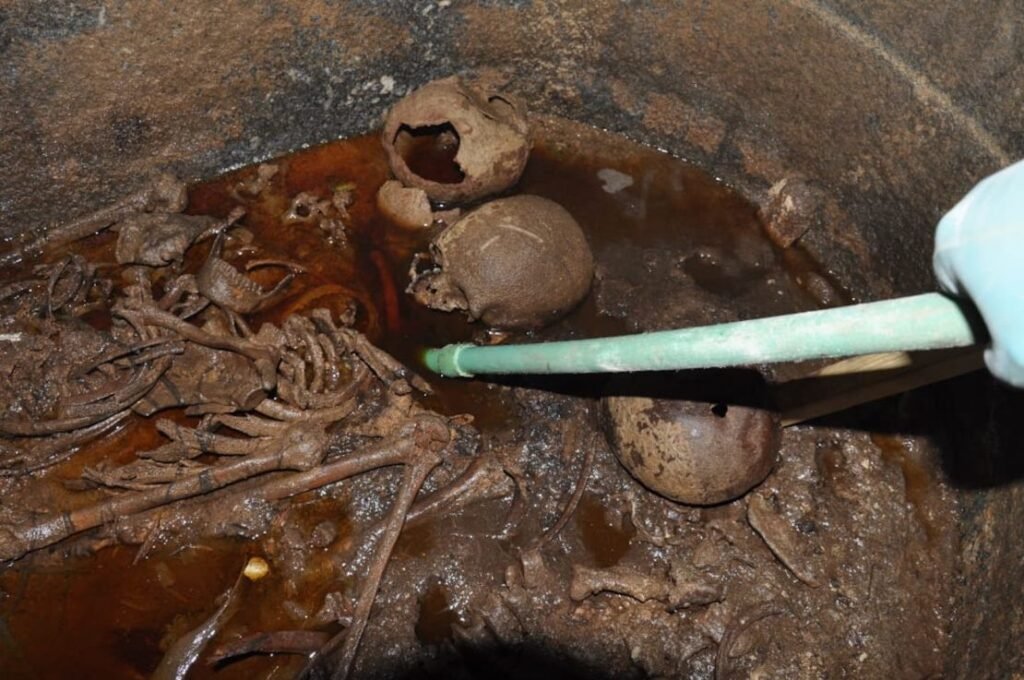
Instead of a preserved mummy, they found the coffin filled with a thick reddish-brown liquid and partially decomposed skeletal remains.
The liquid created a strong odor that quickly spread across the excavation site. Laboratory analysis later confirmed that the fluid consisted mostly of sewage water mixed with decayed organic material that had seeped into the tomb through cracks over centuries.
Inside the sarcophagus were three skeletons placed side by side.
Researchers identified the remains as:
- Two male individuals
- One female individual
Further examination revealed one of the male skulls contained a circular hole likely caused by an arrow or spear wound, suggesting the individual may have died during a battle.
The skeletons were not arranged in the typical Egyptian mummification style. Instead, they appeared to have been buried relatively quickly, which supports the theory that they might have been soldiers or individuals who died under sudden circumstances.
Reports from archaeological studies cited by Live Science and Smithsonian Magazine confirmed that none of the remains showed signs of mummification techniques such as resin treatments or linen wrapping.
Understanding the Ptolemaic Period in Ancient Egypt
To fully appreciate the importance of this discovery, it helps to understand the historical context of the Ptolemaic period, which lasted from 323 BC to 30 BC.
After the death of Alexander the Great, his empire was divided among his generals. One of them, Ptolemy I Soter, took control of Egypt and established the Ptolemaic dynasty.
The Ptolemies ruled Egypt for nearly three centuries, blending Greek traditions with ancient Egyptian customs. During this time:
- Alexandria became a major center of science and learning.
- Trade routes expanded across the Mediterranean.
- Greek culture mixed with Egyptian religion and traditions.
The last ruler of this dynasty was the famous Queen Cleopatra VII, whose reign ended when Egypt became part of the Roman Empire in 30 BC.
Burial practices during this period sometimes reflected both Greek and Egyptian influences. Some individuals were buried in Greek-style tombs, while others followed traditional Egyptian mummification customs.
This cultural blending makes discoveries like the black sarcophagus especially valuable for historians studying how civilizations interacted and evolved.
Why People Thought the Tomb Might Belong to Alexander the Great?
When news of the sealed sarcophagus broke, one theory spread quickly online: that the coffin might contain Alexander the Great himself.
The reason for this speculation lies in a long-standing historical mystery. Despite Alexander being one of the most famous military leaders in history, the exact location of his tomb has never been confirmed.
Ancient sources suggest his body was placed in Alexandria after his death in 323 BC, but over the centuries the location of his burial site was lost.
Because the newly discovered sarcophagus was large, sealed, and located in Alexandria, some observers wondered whether archaeologists had finally discovered the missing tomb.
However, archaeologists quickly dismissed this theory. Alexander’s burial chamber was believed to be far more elaborate and heavily decorated than the plain granite coffin that had been uncovered.
What Scientists Learned From the Mystery of Egypt’s 27-Ton Black Sarcophagus?
Even though the sarcophagus didn’t contain a famous ruler, the remains still provided valuable information.
Experts analyzed the bones to learn about:
Age and Health
Bone structure can reveal the approximate age at death, as well as signs of disease, malnutrition, or injuries sustained during life.
Initial studies suggested the individuals may have been young adults, possibly in their twenties or thirties.
Evidence of Warfare
The hole in one skull strongly indicates a combat-related injury. Archaeologists believe this individual may have died from a projectile weapon such as an arrow or spear.
This supports the idea that the individuals buried in the sarcophagus could have been military personnel.
Burial Practices
The fact that the individuals were buried together suggests they might have shared a relationship—perhaps comrades, family members, or members of a military unit.
Unlike royal burials, there were no jewelry, gold artifacts, or ceremonial items found in the coffin.
This further indicates that the burial was likely practical rather than ceremonial.
Safety and Scientific Procedures Used in the Excavation
Opening an ancient sealed coffin isn’t something archaeologists do casually. The process requires careful planning and strict safety procedures.
Scientists must consider several risks:
- Toxic gases trapped inside ancient tombs
- Bacteria or fungi preserved in sealed environments
- Structural instability of heavy stone lids
Before opening the sarcophagus, specialists used modern excavation tools and protective equipment to safely remove the massive lid.
Researchers also collected samples of the liquid and sediment inside the coffin to study the chemical composition and possible environmental contamination.
This careful approach helps archaeologists avoid damaging valuable artifacts while protecting the health of researchers.
Lessons This Discovery Teaches About Archaeology
For professionals working in archaeology and history, the discovery offers several important lessons.
Not Every Discovery Is a Treasure Trove
Many people imagine archaeology as a hunt for gold and jewels. In reality, most discoveries provide information rather than treasure.
Even simple skeletons can help scientists reconstruct ancient lifestyles, diets, and medical conditions.
Modern Cities Hide Ancient History
The sarcophagus was discovered during routine construction, reminding us that modern cities often sit directly on top of ancient settlements.
This is especially true in historic locations like Alexandria, Athens, Rome, and Jerusalem.
Technology Is Transforming Archaeology
Today’s archaeologists use advanced tools such as:
- CT scans
- DNA analysis
- 3D imaging
- chemical testing
These technologies allow researchers to study remains without damaging them, preserving valuable information for future generations.
Khepri and the Scarab — How Ancient Egypt Symbolized Eternal Return
Gold-Tongued Mummies Unearthed in Egypt Raise New Questions About Afterlife Beliefs
Advanced Scanning Reunites Pieces of an Ancient Egyptian Mask