
Archaeologists studying the Pompeii blue walls of a newly excavated shrine say the striking color reveals the extraordinary cost of decoration in ancient Rome. Scientific analysis suggests the rare Egyptian blue pigment used on the room’s frescoes may have cost nearly as much as a Roman soldier’s yearly salary, underscoring the wealth and status of the household that commissioned it.
The discovery also highlights the advanced artistic techniques and global trade networks that shaped Roman culture nearly two thousand years ago. Experts say the shrine offers new evidence of how wealth, religion, and art were closely intertwined in daily life in Pompeii before the city was destroyed by the eruption of Mount Vesuvius in 79 CE.
Table of Contents
Pompeii’s Stunning Blue Walls
| Key Fact | Detail |
|---|---|
| Location of discovery | Shrine room in Regio IX of Pompeii |
| Pigment used | Egyptian blue, one of the earliest synthetic pigments |
| Estimated pigment quantity | About 2.7–4.9 kilograms |
| Estimated cost | Roughly 93–168 denarii, nearly a Roman soldier’s annual pay |
| Date of destruction | Pompeii buried during Mount Vesuvius eruption in 79 CE |
Discovery of the Pompeii Blue Walls
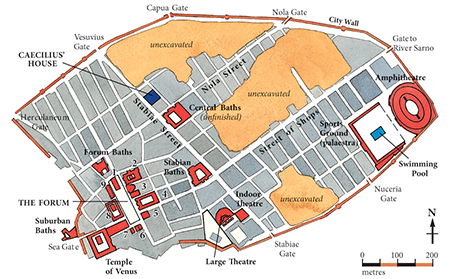
Archaeologists working in the central residential district of Pompeii uncovered the vividly painted room during recent excavations in Regio IX, one of the city’s most active research areas. The excavation is part of an ongoing project aimed at stabilizing ancient structures and uncovering sections of the city that remained buried for centuries.
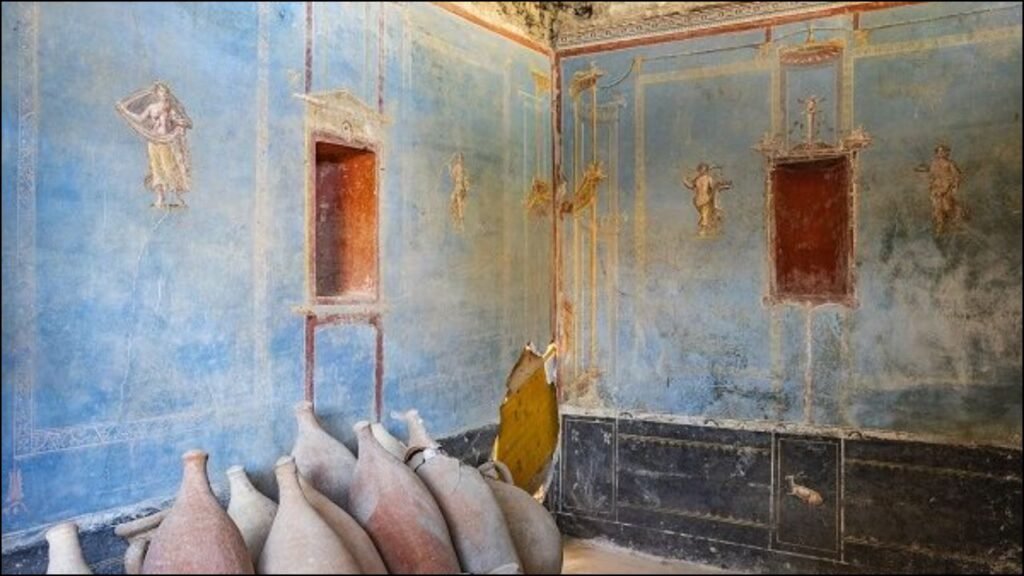
The space, measuring roughly 8–9 square meters, is believed to have served as a sacrarium, or domestic shrine where Roman families performed rituals and stored sacred objects.
Such shrines were common in Roman homes and played an important role in daily life. Families often gathered in these spaces to honor household gods known as Lares and Penates, who were believed to protect the home and ensure prosperity.
What sets this particular shrine apart, however, is the remarkable preservation and color of its walls.
The room’s surfaces are coated with a deep blue pigment rarely seen in Pompeian frescoes. Surrounding the blue background are detailed painted figures, including women dressed in flowing garments and symbolic motifs associated with nature and agriculture.
Researchers believe some of these figures represent the Horae, mythological guardians of the seasons who symbolized the natural cycle of time and agricultural fertility.
The artistic quality of the frescoes suggests the work of skilled painters who were likely trained in established Roman decorative traditions.
Blue was rarely used in Pompeian wall paintings, and when it appeared, it typically marked luxurious or highly decorated rooms, according to archaeologists studying the site.
The Rare Pigment Behind the Pompeii Blue Walls
The color coating the walls comes from Egyptian blue pigment, one of the earliest synthetic pigments produced in human history.
Unlike natural pigments such as ochre or charcoal, Egyptian blue required a complex manufacturing process. Artisans produced it by heating a mixture of silica, limestone, copper compounds, and alkali at temperatures exceeding 800 degrees Celsius.
This reaction created crystals of calcium copper silicate, which give the pigment its distinctive bright blue appearance.
The technology was first developed in ancient Egypt more than 4,000 years ago and later spread throughout the Mediterranean world. By the Roman period, Egyptian blue had become a prized artistic material used in murals, sculptures, and decorative objects.
However, producing the pigment required specialized knowledge and controlled kiln conditions, making it significantly more expensive than most other pigments available to Roman painters.
Researchers studying the shrine estimate that between 2.7 and 4.9 kilograms of Egyptian blue were used to cover the room’s walls.
This suggests that the owners of the house deliberately invested in an expensive decorative scheme to enhance the visual impact of the shrine.
A Pigment Worth a Soldier’s Annual Pay
To understand the cost of decorating the shrine, researchers compared the amount of pigment used with ancient Roman economic records.
Based on historical price estimates, the quantity of Egyptian blue applied to the walls may have been worth 93 to 168 denarii.
For comparison, Roman legionaries in the first century typically earned around 187 denarii per year before deductions for equipment and supplies.
This means the pigment alone could have cost between half and nearly an entire year’s wages for a soldier.
The expense highlights the financial resources available to wealthy residents of Pompeii. For elite families, decorative art was more than aesthetic—it was a public display of prosperity and social status.
Homes in Pompeii often featured elaborate wall paintings, marble decorations, and intricate mosaics designed to impress guests and reflect the owner’s cultural sophistication.
The shrine’s vivid blue walls would have stood out dramatically against the more common red, yellow, and black tones typically seen in Roman frescoes.
What the Shrine Reveals About Roman Society
The discovery provides more than aesthetic insight. Archaeologists say it sheds light on the economic and cultural practices of Roman households.
Private religious practice was a central part of Roman daily life. Unlike many modern religious traditions that emphasize large public temples, Roman spirituality often centered on the home.
Family shrines served as places where residents could make offerings, burn incense, and perform rituals dedicated to protective deities.
The lavish decoration of the shrine indicates that religion and social identity were closely connected. Wealthy families could demonstrate devotion while also showcasing their artistic tastes and financial resources.
The choice of Egyptian blue may also reflect cultural influences from across the Roman Empire.
Trade routes connected Italy with regions throughout the Mediterranean, allowing luxury materials and artistic techniques to circulate widely. Pigments, metals, textiles, and other goods traveled across these networks, shaping the visual culture of Roman cities.
The shrine’s imagery—combining mythological figures with agricultural symbolism—may also reflect Pompeii’s connection to farming and seasonal cycles.
Although Pompeii was a thriving commercial center, much of the surrounding region depended on agriculture, including vineyards and olive groves.
Scientific Study of Ancient Pigments
Modern technology has played a crucial role in identifying and analyzing the pigment used in the Pompeii blue walls.
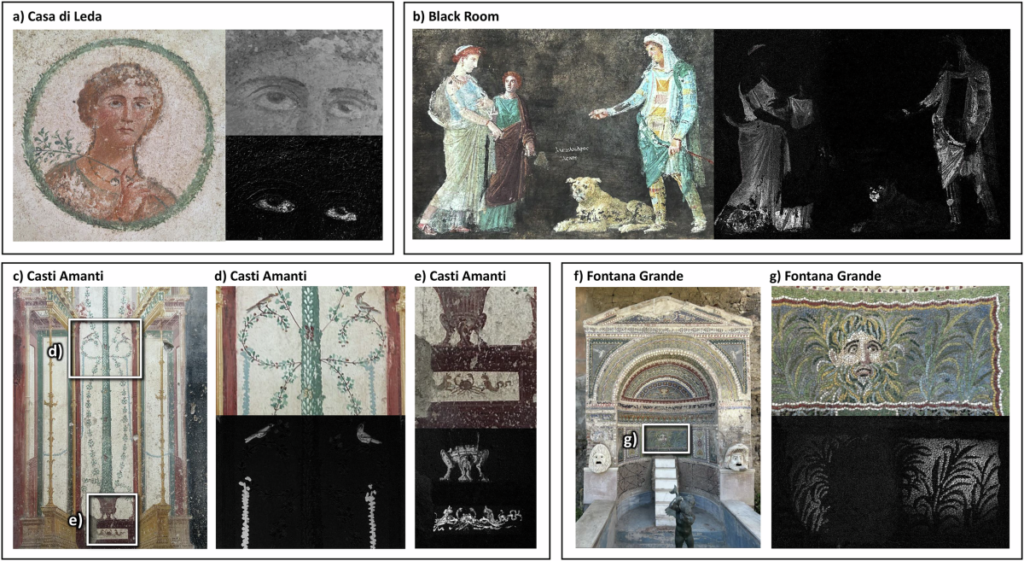
Scientists often examine ancient artworks using tools such as X-ray fluorescence (XRF) spectroscopy, infrared imaging, and microscopic chemical analysis. These techniques allow researchers to determine the precise composition of pigments without damaging the artwork.
Egyptian blue is particularly interesting to scientists because it emits infrared light when exposed to visible radiation. This unusual property makes it easier to detect even when it has faded or been covered by other materials.
Studies of Egyptian blue have also influenced modern research in materials science. Some scientists are investigating the pigment’s unique properties for potential use in advanced imaging technologies and energy-efficient materials.
Ongoing Excavations at Pompeii
The discovery of the Pompeii blue walls is part of a broader archaeological project aimed at preserving and studying the ancient city.
Pompeii remains one of the most significant archaeological sites in the world because of the way it was preserved by volcanic ash.
When Mount Vesuvius erupted in 79 CE, ash and pumice rapidly buried the city, sealing buildings, artworks, and everyday objects beneath layers of debris.
This sudden burial protected many structures from later decay, creating an extraordinary snapshot of Roman life.
Archaeologists continue to uncover new buildings, workshops, gardens, and artworks that help reconstruct the social and economic landscape of Pompeii.
The city once contained more than 13,000 rooms across over 1,000 housing units, ranging from modest apartments to grand villas.
Recent excavations have revealed bakeries, street food stalls, bathhouses, and residential spaces that illustrate how Pompeii functioned as a busy urban center.
The discovery of the shrine adds another layer to this picture by highlighting the importance of domestic religious practice.
Cultural and Artistic Importance of Roman Frescoes
Roman fresco painting was a highly developed art form that followed specific styles and conventions.
Scholars typically classify Pompeian wall paintings into four major decorative styles, each reflecting changing artistic tastes over time.
These styles ranged from simple painted panels designed to imitate marble surfaces to complex illusionistic scenes that created the appearance of architectural depth.
The blue shrine frescoes appear to combine elements of these decorative traditions while emphasizing color and symbolism.
Artists applied pigments to wet plaster so that the paint would bond with the wall as it dried. This technique allowed colors to remain vibrant for centuries, especially when protected from sunlight and weather.
The survival of such bright blue tones after nearly two thousand years highlights the durability of both the pigment and the fresco technique.
FAQ
Why are the Pompeii blue walls significant?
The blue walls are significant because they used Egyptian blue pigment, a rare and expensive material that indicates the wealth of the household that decorated the shrine.
What was the room used for?
Archaeologists believe the room functioned as a sacrarium, a private shrine used for religious rituals and storage of sacred objects.
How expensive was the pigment?
Researchers estimate the pigment used may have cost 93–168 denarii, close to the annual salary of a Roman soldier.
Why was blue rare in Pompeian frescoes?
Blue pigments were difficult and costly to produce, so they were typically reserved for luxury decorations and elite spaces.
How old are the Pompeii blue walls?
The shrine was painted before the 79 CE eruption of Mount Vesuvius, meaning the artwork is nearly 2,000 years old.
Final Context
The Pompeii blue walls illustrate how art, religion, and wealth intersected in ancient Roman households.
The shrine’s vivid color, expensive materials, and carefully designed imagery suggest that the owners of the home sought to create a sacred space that reflected both spiritual devotion and social prestige.
As excavations continue, discoveries like this shrine help historians reconstruct the daily experiences of the people who lived in Pompeii before the catastrophic eruption.
Each new finding adds detail to the story of a city frozen in time—revealing not only the tragedy of its destruction but also the remarkable cultural achievements of the society that once flourished there.