
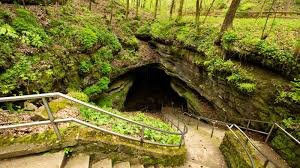
A remarkable Mammoth Cave discovery in Kentucky has revealed fossilized remains of ancient shark-like predators that lived roughly 325 million years ago. Scientists from the U.S. National Park Service and academic researchers say the fossils prove the cave system once lay beneath a shallow tropical ocean, offering new insight into marine ecosystems that existed long before dinosaurs or mammals appeared.
Table of Contents
Ancient Creatures From 325 Million Years Ago Found
| Key Fact | Detail / Statistic |
|---|---|
| Age of fossils | About 325 million years (Carboniferous Period) |
| Species identified | Troglocladodus trimblei and Glikmanius careforum |
| Location | Mammoth Cave National Park, Kentucky |
Further study is expected to continue for decades. As researchers map additional passages, Mammoth Cave may reveal more about the earliest complex ecosystems on Earth, offering scientists and visitors alike a rare connection to a prehistoric ocean that vanished hundreds of millions of years ago.
What the Mammoth Cave Discovery Revealed
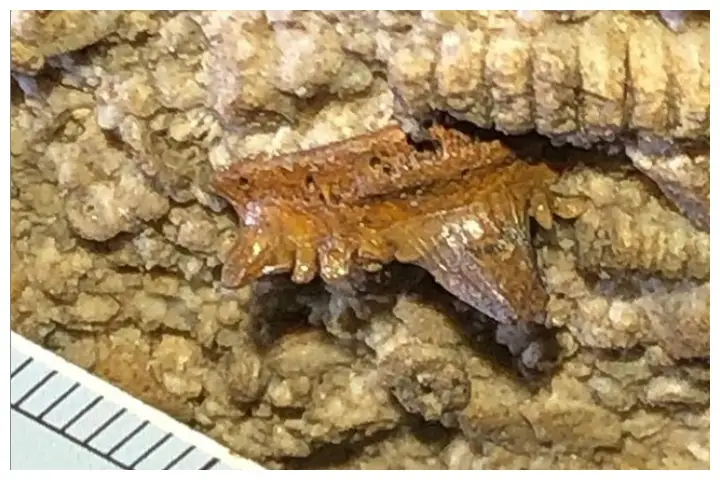
Researchers working with the U.S. National Park Service (NPS) found fossil teeth embedded in limestone ceilings and walls inside the cave passages. Detailed laboratory study confirmed the teeth belonged to two extinct species of ctenacanth sharks.
“These sharks were apex predators of their environment,” said Dr. John-Paul Hodnett, a paleontologist associated with the park’s fossil research program, in an official statement. “They lived tens of millions of years before the first dinosaurs walked on land.”
The species, Troglocladodus trimblei and Glikmanius careforum, reached lengths of approximately 10 to 12 feet. Their sharp, triangular teeth suggest a diet consisting of fish and smaller marine animals.
Scientists say the fossils remain exceptionally well preserved due to the stable cave climate. Constant temperatures and limited airflow slow chemical weathering, allowing delicate structures such as tooth ridges to remain intact.
How the Fossils Were Found
Cave Exploration and Scientific Survey
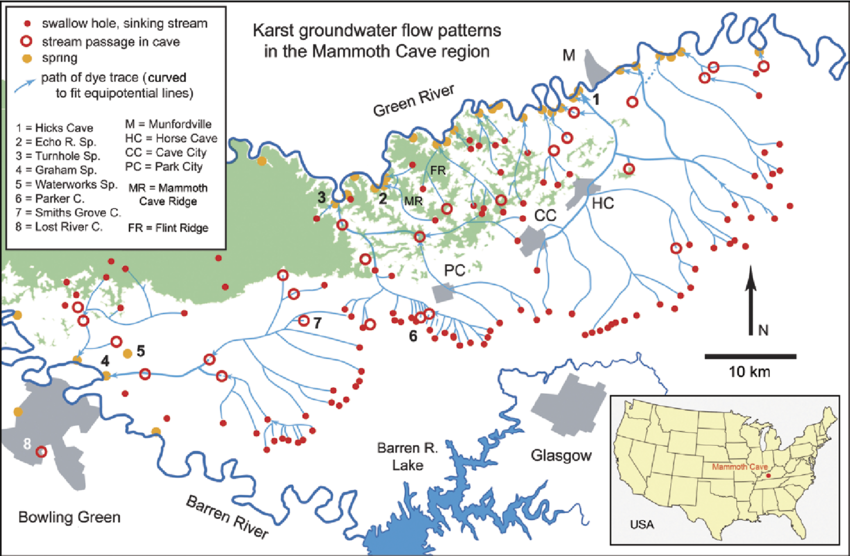
The discovery began during routine cave mapping and resource monitoring conducted by park rangers and researchers. Mammoth Cave contains more than 400 miles (640 kilometers) of mapped passages, and new areas continue to be studied.
A ranger first noticed unusual shapes protruding from the rock ceiling. Specialists later confirmed the formations were fossilized shark teeth.
Unlike traditional excavations, cave paleontology often relies on observation rather than removal. Removing fossils can damage both the specimen and the cave environment. Instead, scientists document them using high-resolution photography, 3-D scanning, and mineral analysis.
“This is a conservation-first approach,” explained Rick Toomey, research coordinator at Mammoth Cave National Park. “We collect information without harming the site whenever possible.”
Why a Cave Contains Marine Fossils
An Ancient Ocean Beneath Kentucky
Around 325 million years ago, North America sat near the equator. The region that is now Kentucky was submerged beneath a warm, shallow sea. Marine animals thrived in coral-rich waters similar to modern tropical coastal environments.
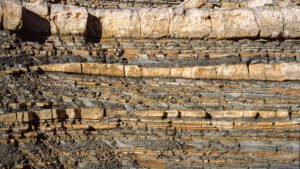
Over time, mud, shells, and skeletal remains accumulated on the seabed. Pressure transformed the deposits into limestone. Later geological uplift raised the rock above sea level.
Rainwater, slightly acidic due to dissolved carbon dioxide, gradually dissolved the limestone. Over millions of years this process carved passages, tunnels, and chambers — creating Mammoth Cave.
“Caves are historical archives,” Toomey said. “The rock around you records ancient climates, oceans, and ecosystems.”
Scientific Importance for Early Shark Evolution
Understanding Ancient Marine Predators
Sharks have existed for over 400 million years, making them older than trees and most land animals. Yet early shark fossils remain scarce because their skeletons were composed mainly of cartilage rather than bone.
Teeth fossilize more easily. Paleontologists compare tooth structure to determine feeding habits and evolutionary relationships.
The Mammoth Cave specimens belong to ctenacanths, an early group of sharks that dominated Carboniferous seas. These animals had distinctive spines near their dorsal fins and streamlined bodies suited for hunting.
“These fossils help us reconstruct evolutionary pathways,” Hodnett said. “They show sharks had already diversified into multiple ecological roles.”
A Larger Prehistoric Ecosystem
The cave system contains more than shark fossils. Scientists have cataloged dozens of marine organisms preserved in rock layers, including:
- Brachiopods (shell-bearing animals)
- Crinoids (sea lilies)
- Ancient corals
- Early bony fish
Together they form a complete marine ecosystem snapshot.
“This is not a single animal discovery,” Toomey noted. “It’s an entire ocean community preserved in stone.”
Life on Earth 325 Million Years Ago
The Carboniferous Period (roughly 359–299 million years ago) marked a major stage in Earth’s history. Conditions differed dramatically from the modern world.
Oxygen levels were higher than today. Vast swamp forests covered continents, eventually forming modern coal deposits. Amphibians thrived, and early reptiles were beginning to evolve.
On land, insects grew unusually large. Fossils show dragonfly-like creatures with wingspans over two feet. Meanwhile, oceans hosted early sharks, armored fish, and primitive relatives of modern rays.
Dinosaurs would not appear until about 100 million years later.
Cultural and Historical Importance of Mammoth Cave
Mammoth Cave is not only a geological site but also a place of human history. Indigenous peoples used the cave thousands of years ago for mining minerals such as gypsum and saltpeter.
During the early 19th century, enslaved workers and explorers mapped parts of the cave while extracting materials for gunpowder production. Some of their routes remain part of guided tours today.
The cave became a national park in 1941 and later earned designation as a UNESCO World Heritage Site.
The fossil discovery adds another layer to its importance — a link not just to human history but to deep geological time.
Preservation and Tourism Balance
The National Park Service restricts access to sensitive fossil areas. Tour routes are carefully planned to protect formations and scientific resources.
Visitors are prohibited from touching walls or removing rocks. Even small disturbances can damage fragile mineral surfaces or erase fossil evidence.
Park officials say education plays a key role. Rangers explain the significance of fossils during guided tours, helping visitors understand conservation.
Research Technology Used
Modern Science Inside an Ancient Cave
Scientists now use advanced tools to study fossils without excavation:
- 3-D laser scanning maps fossil positions
- Digital modeling reconstructs animals
- Isotope analysis estimates water temperature
- Microscopy examines tooth wear patterns
These methods allow scientists to determine diet, habitat, and growth rates.
The Mammoth Cave fossils have been digitally reconstructed to visualize the sharks’ appearance and swimming behavior.
Broader Implications for Climate Science
The discovery also helps climate researchers. Rock layers reveal ancient ocean chemistry and temperature patterns.
By studying marine fossils, scientists learn how ecosystems responded to past climate changes. These long-term records help researchers compare modern environmental shifts with natural historical cycles.
“Deep time records help us understand how life adapts,” Toomey said. “The past informs predictions about the future.”
Looking Ahead
Researchers plan further exploration of unmapped passages. Only a portion of the cave’s full extent has been thoroughly examined, and additional fossils may remain undiscovered.
Scientists hope future surveys will reveal new species and expand understanding of Carboniferous marine life.
“Mammoth Cave still has many secrets,” Hodnett said. “Every expedition adds another piece to Earth’s history.”
FAQs About Ancient Creatures From 325 Million Years Ago Found
What is Mammoth Cave?
It is the world’s longest known cave system, located in Kentucky and protected as a national park and UNESCO World Heritage Site.
How old are the fossils?
They date to about 325 million years ago.
Why are shark fossils inside the cave?
Because the limestone rock forming the cave was once ocean floor sediment.
Are visitors allowed to see the fossils?
Some areas are visible on guided tours, but many are restricted for preservation.
Are these sharks related to modern sharks?
Yes. They are distant ancestors belonging to an early evolutionary branch.