
History is never as fixed as we once think it is. Every few years, new discoveries force us to reconsider what we thought we knew about the past. One of the most fascinating examples of this comes from recent genetic research that is reshaping Britain’s prehistoric story.
For decades, archaeologists debated who the Bronze Age people of Britain really were and how they were connected to earlier communities. Now, cutting edge genome analysis is offering answers that are both surprising and transformative. The big revelation is simple but powerful. Large scale migration played a defining role in shaping Bronze Age Britain. This was not just a cultural shift where ideas traveled slowly across Europe. It was a significant movement of people. Thanks to advanced DNA sequencing, researchers can now trace ancestry patterns with remarkable precision. What they are finding shows that around 2400 BCE, Britain experienced one of the most dramatic genetic turnovers ever recorded in prehistoric Europe. Understanding this migration matters because it connects directly to modern populations. It also changes how we view monuments, traditions, and identities from that era. Britain during the Bronze Age was far more connected to continental Europe than previously believed.
When scientists began extracting ancient DNA from skeletal remains found in Britain, they were not expecting such a clear answer. The genetic data revealed that individuals buried during the early Bronze Age were very different from the Neolithic farmers who lived there before them. These earlier farmers had descended from populations that migrated from Anatolia thousands of years earlier. They built impressive stone monuments and established long standing agricultural communities. Then, around 2400 BCE, something shifted dramatically. Genetic signatures associated with Steppe ancestry began appearing in Britain. These markers were linked to populations that had already spread across much of continental Europe. Within just a few centuries, the genetic landscape of Britain had changed almost completely in some regions. Studies suggest that as much as 80 to 90 percent of the earlier Neolithic ancestry was replaced. This level of demographic change is extraordinary. It tells us that the arrival of Bronze Age migrants was not a minor event. It was a turning point that reshaped the population structure of the entire island.
Table of Contents
True Origins of Britain’s Bronze Age Migrants
| Key Aspect | Details |
|---|---|
| Time Period | Around 2400 BCE |
| Cultural Association | Beaker culture |
| Ancestral Origin | Continental Europe with strong Steppe ancestry |
| Genetic Impact | Up to 90 percent replacement of Neolithic ancestry in some areas |
| Evidence | Ancient DNA from skeletal remains |
| Long Term Effect | Foundation for much of Britain’s later genetic makeup |
The Arrival of the Beaker People
- The story of these migrants is closely tied to what archaeologists call the Beaker culture. This culture is named after its distinctive bell-shaped pottery, which appears in burial sites across Europe. For many years, scholars debated whether the spread of Beaker artifacts represented cultural exchange or actual migration. The DNA evidence strongly supports migration. Individuals buried with Beaker pottery in Britain share genetic similarities with people from the Netherlands, Germany, and other parts of mainland Europe. They carried high levels of Steppe related ancestry, which had spread westward centuries earlier.
- When these groups arrived in Britain, they did not simply blend gradually into the existing population. The genetic data suggests rapid demographic change. Over a relatively short period of time, the descendants of Neolithic farmers became a minority in many areas. This pattern indicates sustained migration and population growth rather than occasional contact. It is important to note that migration does not automatically mean violent conquest. Population replacement can happen through a combination of social advantages, higher birth rates, or shifting alliances. While the exact dynamics remain debated, the scale of genetic turnover is clear.
A Genetic Turning Point
- Before the Bronze Age transition, Britain’s population was relatively stable in genetic terms. Communities were rooted in farming traditions and shared ancestry that stretched back thousands of years. The arrival of Steppe influenced migrants marked a sharp break in that continuity.
- One of the most striking findings involves Y chromosome lineages, which trace paternal ancestry. During the early Bronze Age, these lineages shifted dramatically toward types associated with Steppe populations. This suggests that many of the incoming migrants were male. However, women were also clearly part of the migration, as mitochondrial DNA shows mixed ancestry patterns over time.
- As generations passed, intermarriage created a blended population. The genetic foundation laid during this period still contributes to the ancestry of people living in Britain today. That continuity makes this prehistoric migration more than an academic curiosity. It is part of the deep story of modern identity.
Cultural Change and Technological Innovation
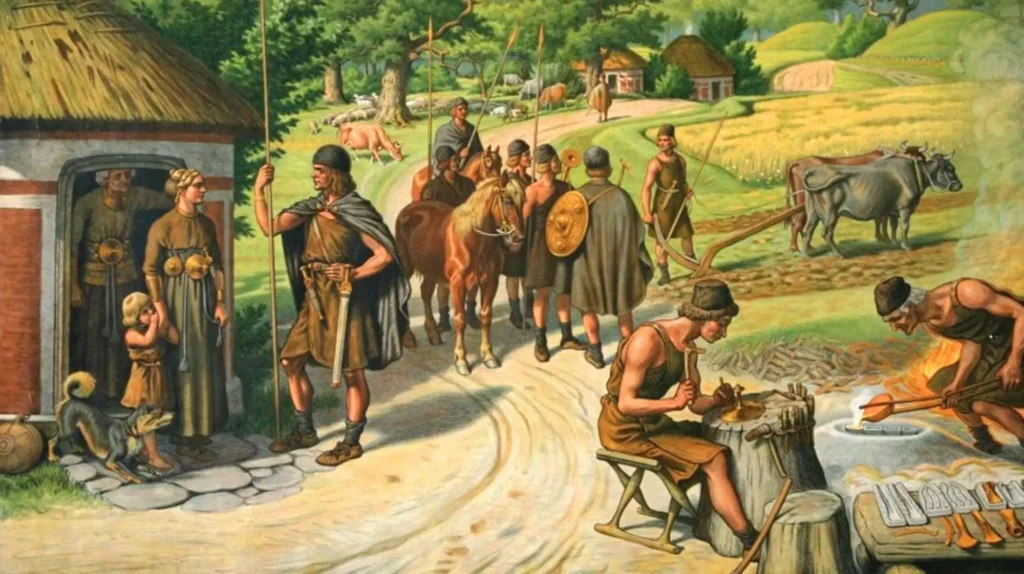
- Migration during the Bronze Age was not only about genes. It also brought technological and cultural transformation. Bronze tools and weapons replaced many stone implements. Metalworking techniques spread rapidly, enabling stronger farming tools and more effective weapons. Trade networks expanded as well. Britain was connected to continental Europe through maritime routes. The Channel was not a barrier but a bridge. Goods, ideas, and people moved back and forth with surprising regularity.
- Burial customs changed noticeably. Earlier Neolithic communities often used communal tombs. In contrast, Bronze Age graves were more likely to be individual, sometimes accompanied by personal items such as daggers, ornaments, and pottery. These changes suggest shifts in social organization and possibly the emergence of new forms of leadership. The link between migration and cultural change is reinforced by the DNA evidence. The people introducing these innovations were not simply adopting foreign styles. They were, in many cases, newcomers carrying distinct ancestry.
Rethinking Stonehenge and The Late Neolithic
- One of the most intriguing aspects of this research involves Stonehenge. This iconic monument was built before the major Bronze Age migration. It was constructed by Neolithic communities whose genetic signatures were later largely replaced.
- However, Stonehenge continued to be used and modified into the Bronze Age. That continuity shows that incoming migrants did not erase the landscape of the past. Instead, they integrated existing monuments into their own cultural frameworks.
- This layered history challenges simplistic narratives. Britain’s past was neither entirely continuous nor completely disrupted. It was a complex blend of inheritance and transformation.
The Broader European
Britain’s Bronze Age migration was part of a much larger European pattern. Steppe ancestry had already reshaped populations in Central and Western Europe before reaching the British Isles. By the time migrants crossed into Britain, they were part of a widespread continental network. Genetic similarities between early Bronze Age Britons and populations from the Netherlands and Germany highlight these connections. Maritime travel was clearly established. Far from being isolated at the edge of Europe, Britain was an active participant in prehistoric mobility. Understanding this broader context helps explain why the genetic shift in Britain was so extensive. It was the final stage of a long westward movement that had been unfolding for centuries.
What Ancient DNA Can And Cannot Tell Us
Ancient DNA has revolutionized archaeology, but it has limits. It can reveal ancestry, migration patterns, and degrees of population mixing. It cannot directly tell us what language people spoke or what myths they believed. Some researchers link Steppe migrations to the spread of Indo-European languages. While the timing aligns, language leaves no genetic signature. That question remains open to debate. Still, the evidence for migration itself is overwhelming. Advances in sequencing technology have increased the number of samples available for analysis. Larger datasets make conclusions more reliable than ever before.
A New Understanding Of Britain’s Past
- What does all this mean for our understanding of history. It means that Britain’s Bronze Age was not simply an internal evolution of earlier communities. It was shaped by movement, exchange, and transformation on a massive scale. The idea of a stable, isolated island population no longer holds. Instead, Britain appears as a dynamic crossroads where people from different regions met and formed new identities. Migration was not an exception. It was a central feature of prehistoric life.
- For modern readers, this research offers a powerful reminder. Human history has always been marked by movement. The deep past shows that cultural and genetic change are normal parts of the human story. As research continues, more details will emerge. New discoveries may refine timelines or reveal additional migration waves. But one thing is clear. The Bronze Age migration into Britain was one of the most significant turning points in the island’s early history.
- The combination of archaeology and genetics has given us a clearer window into that transformation. Instead of relying solely on artifacts, we can now listen to the biological echoes preserved in ancient bones. They tell a story of journeys across water, of communities reshaped, and of identities redefined. Britain’s Bronze Age was not a quiet chapter in history. It was an era of profound change, driven by people who crossed the Channel and left a lasting imprint on the land and its future generations.
FAQs on Britain’s Bronze Age Migrants
1. When Did The Bronze Age Migration To Britain Happen
The major migration associated with the Beaker culture began around 2400 BCE. This marks the start of the Early Bronze Age in Britain and coincides with a dramatic genetic shift identified through ancient DNA studies.
2. Where Did Britain’s Bronze Age Migrants Come From
Genetic research shows that these migrants came from continental Europe, particularly regions linked to Steppe ancestry.
3. Did The Migrants Completely Replace The Neolithic Population
In some parts of Britain, up to 80 to 90 percent of the earlier Neolithic ancestry was replaced within a few centuries.
4. Is There A Connection Between This Migration And Indo European Languages
Some scholars suggest that Steppe related migrations may be linked to the spread of Indo-European languages.