
Daylight Saving Time Is Staying Until 2026, according to existing federal law, after years of congressional debate failed to produce a permanent change. Despite bipartisan support to end the twice-yearly clock adjustments, the United States will continue moving clocks forward in spring and back in fall, keeping a system that affects daily life, health, and the economy.
Table of Contents
Daylight Saving Time Is Staying Until 2026
| Key Fact | Detail |
|---|---|
| DST legal status | Remains unchanged through 2026 |
| Spring change 2026 | March 8, 2026 |
| Fall change 2026 | November 1, 2026 |
| Congressional action | No bill enacted |
For now, Daylight Saving Time Is Staying Until 2026, reflecting a broader inability to resolve a debate that blends science, economics, and public preference. Until lawmakers agree on a permanent path forward, Americans will continue living by the clock changes they know well.
Confirmed Daylight Saving Time Dates for 2026
Under the Uniform Time Act, the national schedule for Daylight Saving Time remains intact. In 2026, clocks will move forward one hour at 2:00 a.m. local time on Sunday, March 8, marking the start of Daylight Saving Time. The period will conclude on Sunday, November 1, when clocks are set back one hour.
These dates follow a framework established in 2007, when Congress extended Daylight Saving Time by several weeks. Since then, no subsequent legislation has altered the schedule, even as public debate has intensified.
Why Daylight Saving Time Is Staying Until 2026
Authority over time observance rests solely with Congress, while implementation is handled by the Department of Transportation. Although lawmakers have introduced numerous bills to end clock changes, none have passed both chambers and been signed into law.
The most prominent effort, the Sunshine Protection Act, proposed making Daylight Saving Time permanent nationwide. The Senate approved the bill unanimously in 2022, but it stalled in the House of Representatives amid concerns about health impacts and regional daylight differences.
Without new legislation, the existing system remains binding. As federal officials have repeatedly stated, no administrative action can override statutory requirements.
A Long and Contested History of Time Changes
The idea behind Daylight Saving Time dates back more than a century. The United States first adopted it during World War I as a fuel-saving measure, then repealed it. It returned during World War II under the name “War Time” before again becoming optional.
The modern framework emerged in 1966 with the Uniform Time Act, which sought to standardize time observance nationwide while allowing states to opt out. Since then, Congress has adjusted the calendar several times, often citing economic benefits tied to longer evening daylight.
Each change, however, has reignited debate about whether the system delivers meaningful advantages.
Health Implications and Scientific Concerns
Medical researchers have increasingly questioned the impact of clock changes on human health. Studies published in peer-reviewed journals have linked the spring transition to short-term increases in heart attacks, strokes, and traffic accidents.
Sleep specialists argue that darker winter mornings under permanent Daylight Saving Time could be particularly harmful. “Morning light is critical for regulating circadian rhythms,” said Dr. Beth Ann Malow, a neurologist at Vanderbilt University Medical Center, in congressional testimony.
Public health groups, including the American Academy of Sleep Medicine, have urged lawmakers to adopt permanent standard time instead, citing evidence of improved sleep quality and reduced health risks.
Economic Effects of Daylight Saving Time
Supporters of Daylight Saving Time have long argued that extended evening daylight boosts retail sales, recreation, and tourism. Golf courses, restaurants, and outdoor venues often see increased activity during longer summer evenings.
However, economists say the overall economic impact is relatively small and uneven. Studies examining energy use have found modest reductions in lighting demand offset by increased air conditioning use, particularly in warmer states.
Transportation analysts also point to productivity losses associated with sleep disruption following clock changes. While difficult to quantify precisely, these effects contribute to the ongoing debate.
What Americans Think About Clock Changes
Public opinion consistently shows frustration with the biannual clock shift. A survey by the Pew Research Center found that a majority of Americans favor ending the practice altogether.
However, respondents are divided over which system should replace it. Some prefer permanent Daylight Saving Time for brighter evenings, while others favor permanent standard time for health and safety reasons.
This lack of consensus has complicated legislative efforts, as lawmakers balance competing preferences across regions and industries.
States, Exceptions, and Legal Limits
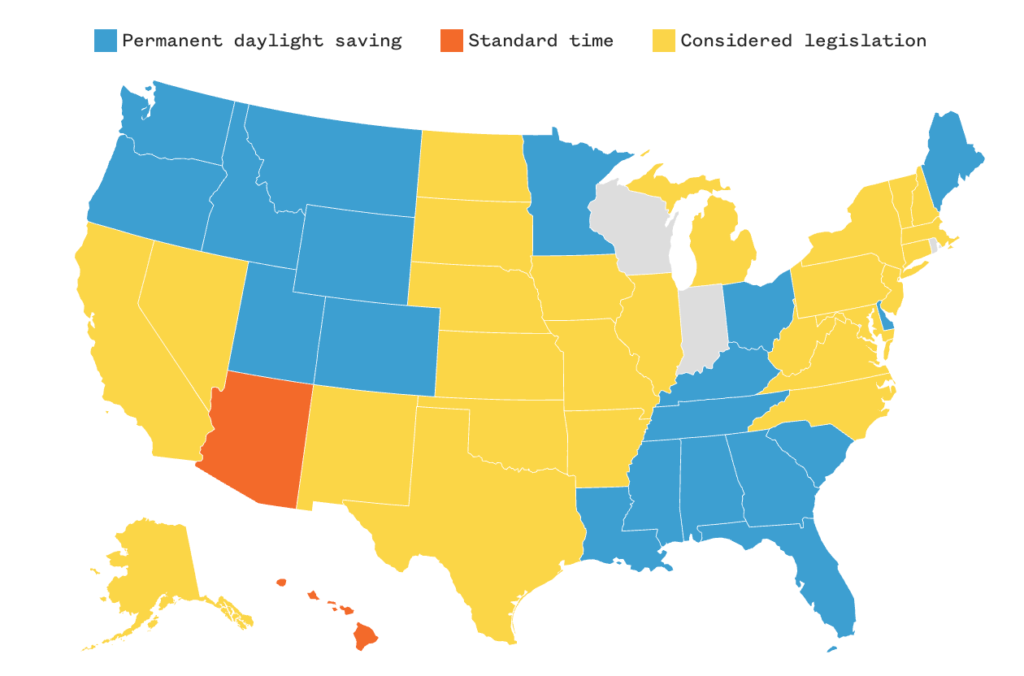
Federal law allows states to opt out of Daylight Saving Time but does not permit them to adopt it permanently without congressional approval. As a result, Hawaii and most of Arizona remain on standard time year-round.
Several states have passed laws expressing intent to adopt permanent Daylight Saving Time if Congress authorizes it. Until then, those measures remain symbolic.
International Perspective: How the U.S. Compares
The United States is far from alone in grappling with time changes. Most European countries observe Daylight Saving Time, though the European Union voted in 2019 to allow member states to abandon the practice. Implementation has been repeatedly delayed.
Countries such as Japan, India, and China do not observe Daylight Saving Time at all. Their experiences are often cited by U.S. critics who argue that modern economies function effectively without clock changes.
Why Change Has Proven So Difficult
Despite broad agreement that the current system is unpopular, several factors have stalled reform. Regional differences in sunrise and sunset times complicate nationwide solutions. Northern states experience much later winter sunrises under permanent Daylight Saving Time, raising safety concerns for schoolchildren and commuters.
Industry lobbying also plays a role. While some sectors support permanent DST, others quietly favor the status quo, which they have already adapted to operationally.
What Happens After 2026
There is no sunset clause attached to the current law. If Congress does not act, the same schedule will apply in 2027 and beyond.
Transportation officials have emphasized that any change must come through legislation. Until then, Americans should expect the familiar ritual of adjusting clocks twice a year to continue.
As debates resume in future congressional sessions, lawmakers will again face the challenge of reconciling science, public opinion, and regional realities.
FAQs About Daylight Saving Time
Q: Is Daylight Saving Time ending in 2026?
No. There is no law scheduled to take effect in 2026 that would end or change the practice.
Q: Can states choose permanent Daylight Saving Time?
No. States need congressional approval to adopt permanent DST.
Q: Why not switch to permanent standard time instead?
That option is supported by many health experts but lacks broad political consensus.