
Imagine climbing a massive sand dune just after sunrise. The desert looks silent, almost frozen in time. Then, without warning, the ground beneath your feet begins to vibrate. A deep humming sound rolls through the air, steady and powerful, as if the earth itself is breathing.
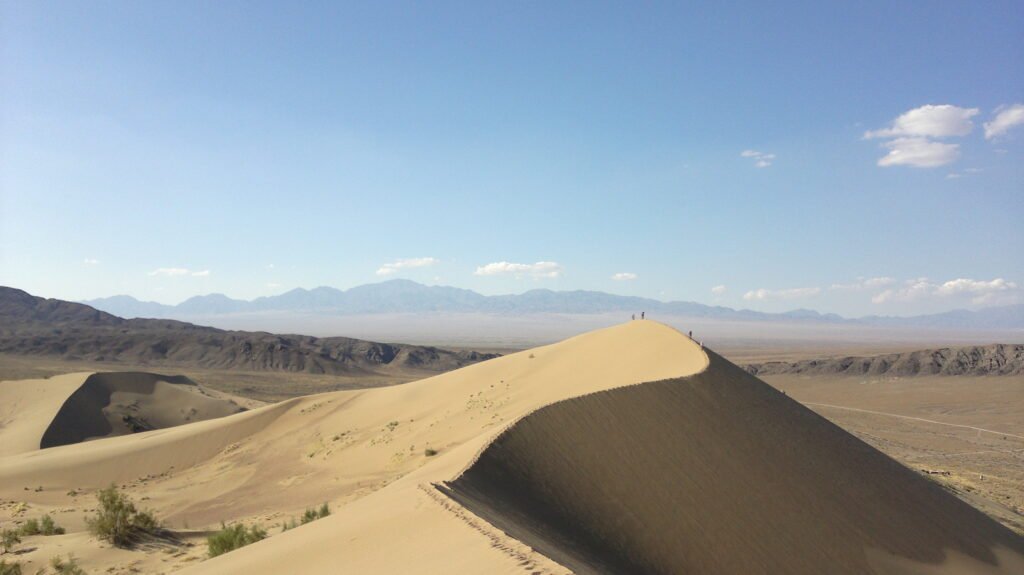
This strange event is real, and it has puzzled people for centuries. The mystery of Desert Singing Sands has fascinated travelers, explorers, and researchers alike. Many early visitors described Desert Singing Sands as the voice of spirits or the echo of buried cities because the sound feels far too loud to come from loose grains of sand. Today, science offers a clearer explanation. The dunes are not quiet landscapes. Under very specific conditions, they can behave like giant musical instruments. The sound is not produced by wind alone, and it is not an illusion. Instead, it comes from movement, vibration, and an almost perfect arrangement of sand particles working together.
The term Desert Singing Sands describes a rare natural acoustic phenomenon in which certain sand dunes produce a low, musical hum when the sand begins to slide. This usually happens during a small avalanche triggered by footsteps, animals, or even shifting air currents. Scientists discovered the sound occurs when millions of sand grains move together in synchronized motion, pushing air and creating resonance. Only a handful of dunes on Earth can produce this effect. The sand must be extremely dry, smooth, and nearly identical in size. The sound typically falls between 70 and 110 hertz, which is similar to a deep bass musical note. Field recordings from recent studies show that each dune tends to maintain a consistent tone, almost like it has its own musical identity.
Table of Contents
Why Desert Singing Sands Create a Deep Mysterious Hum
| Aspect | Key Information |
|---|---|
| Sound Type | Deep humming or booming tone |
| Frequency | Around 70–110 Hz |
| Cause | Sand avalanche and synchronized grain movement |
| Required Conditions | Dry climate, smooth rounded grains, uniform size |
| Amplification | Air vibration and dune resonance |
| Locations | Sahara, Gobi Desert, Death Valley and Morocco dunes |
| Duration | Seconds to several minutes |
| Scientific Field | Granular physics and acoustic resonance |
What Are Singing Dunes
- Singing dunes, often called booming dunes, are tall sand formations capable of producing sound when the upper layer collapses and flows downward. These dunes usually form in extremely dry climates where strong winds constantly move sand across the landscape. Over long periods, the moving grains polish one another until they become smooth and rounded.
- Famous examples exist in Morocco’s Sahara Desert, the Badain Jaran Desert in China, and Death Valley in California. Visitors often trigger Desert Singing Sands simply by walking or running down the slope. The moment the sand begins sliding, the sound appears. Sometimes the humming continues even after the person stops moving because the avalanche keeps traveling down the dune.
- The sound has been compared to thunder, an airplane engine, and even a distant drumbeat. Hearing it in person is unforgettable because the noise feels as if it comes from inside the ground rather than the air.
How The Hum Forms
- The hum begins with motion. When sand slides down a steep slope, thousands of grains collide with each other repeatedly. Normally this would create a soft rustling noise. But in singing dunes, something remarkable happens. The grains begin moving in rhythm.
- Instead of random impacts, the grains organize into thin layers that vibrate together. Each grain strikes its neighbor at nearly the same timing. This synchronized movement produces vibration waves that travel through the dune.
- The dune itself then works like the body of a musical instrument. The vibration pushes surrounding air outward, and the air amplifies the sound. The result is a continuous hum that can carry across a large distance. Scientists now recognize Desert Singing Sands as a striking example of collective motion in nature, where simple particles behave as one coordinated system.
The Role Of Grain Size And Shape
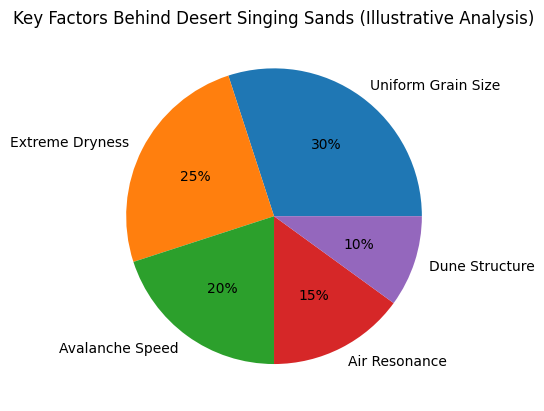
- The shape and size of sand grains play a crucial role in whether a dune can sing. The grains must be smooth, rounded, and almost identical. If the sand contains sharp edges or a mixture of sizes, the sound disappears.
- Rounded grains slide smoothly over each other, allowing consistent spacing and rhythm. When grains are uneven, they interrupt each other’s motion and destroy the vibration pattern. Most singing dunes contain grains measuring about 0.2 to 0.4 millimeters across.
- Because of this uniformity, the sand behaves less like a pile of particles and more like a vibrating sheet. This is why Desert Singing Sands produce a steady tone instead of a chaotic noise. It is similar to how identical strings on a musical instrument produce clear notes.
Dryness And the Importance of Air
- Moisture completely stops the phenomenon. Even slight humidity prevents the sand from sliding freely. Water forms tiny bridges between grains and increases friction, which blocks vibration.
- For that reason, dunes are most active during hot, dry weather. After rain or heavy morning dew, the sound disappears. Once the sand dries again, the Desert Singing Sands return.
- Air trapped between grains is also essential. As the sand layer moves, air pockets compress and expand rapidly. These pressure changes strengthen the sound waves and make the hum louder. Without the movement of air, the sound would be barely noticeable.
How Scientists Tested The Mystery
- For many years researchers struggled to explain the sound. Early ideas included wind echoing inside dunes or underground cavities acting like pipes. None of these theories matched observations.
- Eventually, scientists recreated miniature dunes in laboratories. They poured sand down sloped surfaces and recorded the sound using sensitive equipment. High speed cameras tracked how grains moved during the avalanche.
- The results were clear. When the sand was dry and uniform, a loud tone appeared. When moisture or mixed grain sizes were introduced, the sound vanished immediately. These experiments proved the hum came from synchronized grain collisions, not from wind. This research confirmed the true mechanism behind Desert Singing Sands.
Why The Sound Has A Specific Pitch
- Each dune produces a consistent musical note. The pitch depends mainly on the speed and thickness of the sliding sand layer. Faster movement creates more frequent collisions and a higher tone. Slower avalanches produce deeper sounds.
- This explains why some dunes boom like thunder while others hum softly. Measurements taken in different deserts show that a single dune often repeats the same frequency every time it sings. The Desert Singing Sands therefore behave like a natural instrument tuned by physics.
Why This Discovery Matters
- Understanding this phenomenon is more important than it first appears. It helps scientists study granular materials such as sand, snow, and industrial powders. These materials behave partly like solids and partly like liquids, making them difficult to predict.
- Industries storing grains, cement, or pharmaceutical powders must understand vibration behavior to prevent structural damage in storage containers. Research into Desert Singing Sands helps engineers design safer systems.
- The discovery also matters for space exploration. Mars contains massive dune fields. If similar sand movement occurs there, it could reveal information about Martian surface conditions and atmosphere. Studying dunes on Earth helps scientists interpret landscapes on other planets.
A Natural Instrument Hidden In The Desert
- The desert appears silent, but it holds hidden activity. When conditions align perfectly, a dune transforms into a musical instrument powered only by gravity and motion. No machines, no electricity, just grains of sand sliding together.
- The sound feels ancient and powerful because it is produced on a massive scale. Millions of particles moving in harmony create a voice that echoes across the empty landscape. The Desert Singing Sands are not myth or illusion. They are a beautiful example of nature organizing simple elements into something extraordinary.
- Standing on a singing dune, a person hears more than noise. They hear physics made audible. A footstep begins the motion, gravity carries it forward, and the desert answers with a deep, steady hum that lingers in memory long after the sound fades.
FAQs on Desert Singing Sands
What causes desert dunes to produce sound
The sound forms when a layer of sand slides down the slope and grains collide in synchronized motion, creating vibration and resonance.
Are singing dunes common
No. Only a small number of dunes worldwide have the exact grain size, dryness, and structure required.
Can the sound happen naturally without people
Yes. Strong winds or natural avalanches can trigger the humming effect without human presence.
Where can someone hear it
You can experience it in parts of the Sahara Desert, Death Valley in the United States, and certain dunes in China’s Gobi Desert.