
Astronomers say the Milky Way–Andromeda encounter—long predicted as an inevitable cosmic collision—may not occur after all. New measurements released in 2025 combining data from major space observatories suggest the two galaxies could pass one another at a distance instead of merging. The findings reshape scientific understanding of the Local Group and improve long-term galaxy collision prediction, a key topic in modern astrophysics.
Table of Contents
Long-Term Path of the Milky Way–Andromeda Encounter
| Key Fact | Detail |
|---|---|
| Collision probability | Roughly a 50% chance of no merger within 10 billion years |
| Earliest close approach | About 4–5 billion years from now |
| Earth’s future | Solar evolution likely ends habitability before encounter |
Whether collision or near-miss, the event lies billions of years in the future. The research mainly improves scientific understanding of galaxy motion and dark matter rather than posing any concern for life today. Astronomers emphasize the study highlights humanity’s growing ability to predict cosmic events across timescales far beyond human history.
Updated Calculations Challenge a Long-Held Prediction
For years, textbooks described the future of our galaxy in simple terms: the Milky Way would eventually collide with the Andromeda galaxy, also called Messier 31. Earlier predictions were based on Andromeda’s measured speed toward the Milky Way and the gravitational attraction between the two giant spiral galaxies.
The new research relied on more precise observations from the Hubble Space Telescope and the European Space Agency’s Gaia mission, a satellite that tracks positions and motions of more than a billion stars. Scientists ran tens of thousands of computer simulations to model the future.
Instead of a guaranteed crash, astronomers now see multiple possible outcomes.
“The Local Group is not a two-body system,” researchers explained in their analysis. “Several neighboring galaxies influence the final trajectory.”
This discovery reframes the Milky Way–Andromeda encounter as a probability rather than destiny.
A Century-Old Mystery Finally Refined
The question of whether Andromeda is approaching the Milky Way dates back more than 100 years. In 1912, American astronomer Vesto Slipher measured Andromeda’s motion using spectroscopy. He found its light was blue-shifted, meaning the galaxy was moving toward Earth.
Later observations confirmed Andromeda approaches at about 110 kilometers per second (roughly 250,000 miles per hour).
In the 1920s, astronomer Edwin Hubble proved Andromeda was not a cloud within our galaxy but an entirely separate galaxy millions of light-years away. That discovery expanded humanity’s understanding of the universe and created the first true evidence of galaxy mergers occurring in cosmic history.
Today’s research builds directly on those earlier measurements but uses instruments far more precise than those available a century ago.
Why Nearby Galaxies Matter
The Hidden Influence of the Large Magellanic Cloud
Astronomers discovered the Large Magellanic Cloud, a satellite galaxy orbiting the Milky Way, significantly changes gravitational calculations. Although smaller, it contains large amounts of dark matter, which contributes extra gravitational pull.
This subtle influence shifts the Milky Way’s path over billions of years.
The Role of the Triangulum Galaxy
Another nearby galaxy, the Triangulum Galaxy (M33), orbits Andromeda and alters its trajectory. The system therefore behaves like several gravitational partners rather than a simple pair.
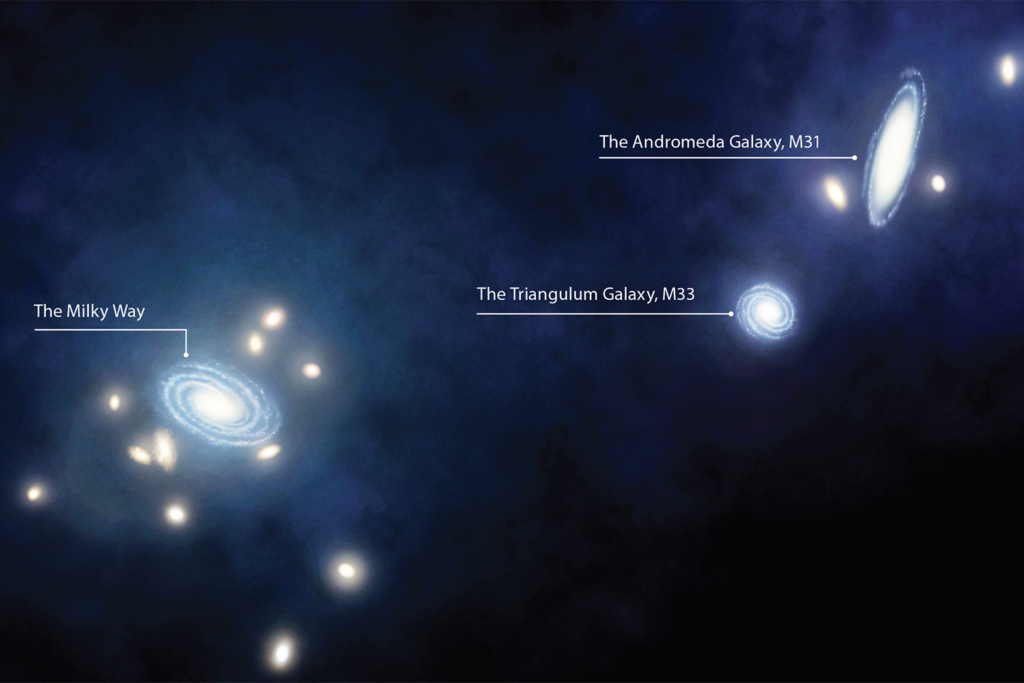
Because gravity works across enormous distances and timescales, tiny changes in mass distribution can significantly alter the outcome. This phenomenon is similar to chaotic systems studied in physics, where long-term prediction becomes difficult.
What Would Happen During the Milky Way–Andromeda Encounter?
Even if the galaxies intersect, the event would not resemble a violent crash like two solid objects.
Galaxies consist mostly of empty space. Stars are separated by trillions of kilometers. Astronomers estimate the chance of two stars colliding directly is extremely small.
Instead, gravity would reshape the galaxies.
Expected effects include:
- Massive streams of stars pulled outward
- Increased star formation from compressed gas
- Possible creation of a giant elliptical galaxy after billions of years
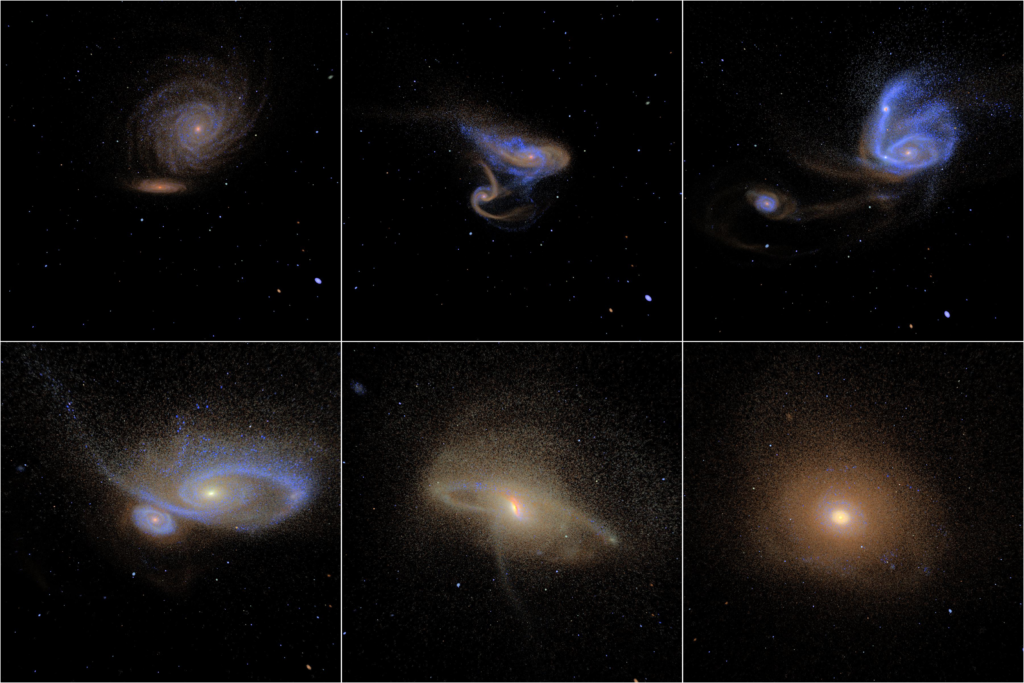
This process, known as galaxy merger evolution, is common across the universe. Astronomers observe similar collisions in distant galaxies today, providing a preview of the Milky Way’s potential future.
What the Night Sky Would Look Like
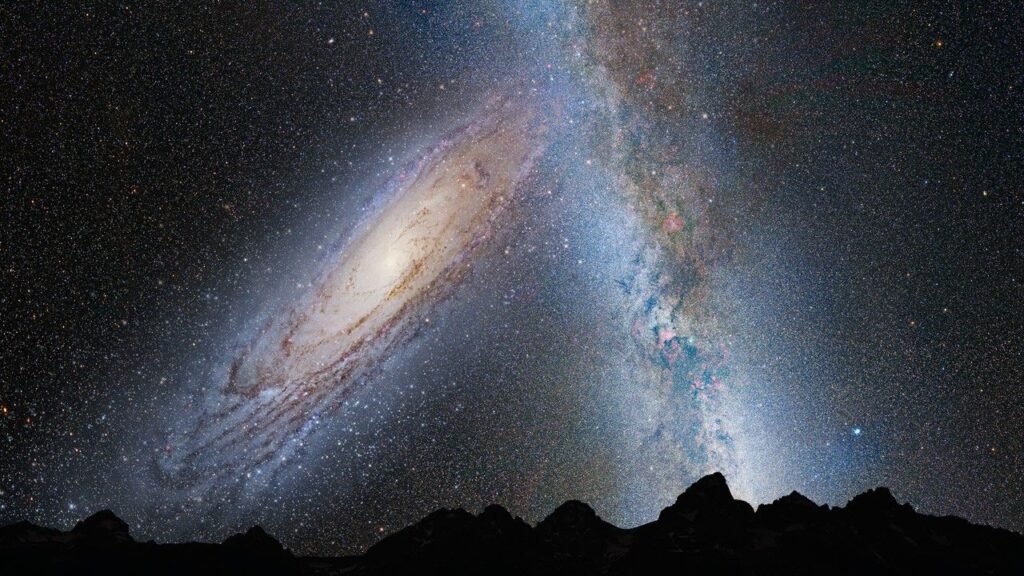
One of the most striking consequences of the Milky Way–Andromeda encounter would be visual.
Billions of years from now, Andromeda would appear larger than any object in Earth’s sky today. It would gradually expand over millions of years, eventually spanning much of the visible sky.
Astronomers predict:
- Bright streams of stars crossing the sky
- New star clusters forming
- Possible multiple galactic cores visible simultaneously
The sky would change slowly enough that any observers—if they existed—would see gradual transformation across generations rather than sudden events.
Timeline: A Very Distant Future
Researchers estimate the first close approach could occur about 4–5 billion years from now. A full merger, if it happens, may take another 4–6 billion years.
However, Earth is unlikely to witness any of it.
The Sun naturally brightens as it ages. Astrophysicists calculate that increasing solar radiation may evaporate Earth’s oceans in roughly one billion years. Later, the Sun will expand into a red giant star.
Thus, the Milky Way–Andromeda encounter is scientifically important but not a threat to humanity.
What the Discovery Means for Astronomy
The revised prediction changes more than just our galaxy’s future. It alters how astronomers understand galactic motion throughout the universe.
Scientists now realize predicting galaxy behavior requires modeling entire gravitational environments, including dark matter halos. The research strengthens the field of cosmic evolution studies, which examines how galaxies grow, merge, and transform over billions of years.
Gaia’s precision is critical. Its measurements detect stellar movement as small as a fraction of a pixel across the sky over years. This accuracy allows astronomers to reconstruct the history of galaxy motion across cosmic time.
Implications for Dark Matter Research
The Milky Way–Andromeda encounter also informs the study of dark matter, the invisible substance believed to make up most of the universe’s mass.
Galaxies are surrounded by massive dark matter halos. These halos influence motion even more than visible stars. Differences in halo mass significantly affect whether galaxies merge or pass by each other.
By measuring future motion, astronomers can estimate the true mass of dark matter around both galaxies. This may help solve one of physics’ biggest unanswered questions: what dark matter actually is.
Could the Solar System Move?
One possibility raised by simulations is stellar migration.
During a close encounter, gravitational forces could move stars to different galactic regions. The Sun itself might drift farther from the galactic center or be thrown into a new orbit around a merged galaxy.
Importantly, this would not be dangerous. The distances involved are vast, and planetary systems would remain gravitationally bound to their stars.
Implications for Cosmic Forecasting
Astronomers say predicting the universe resembles forecasting weather across billions of years.
Small uncertainties accumulate over time, creating multiple possible futures. The Milky Way–Andromeda encounter now serves as a scientific example of long-term gravitational unpredictability.
Instead of certainty, scientists present probability ranges.
Looking Ahead
Future Gaia data releases will improve measurements of stellar velocities and galactic mass. Next-generation observatories will also map dark matter more precisely.
As observational accuracy improves, scientists expect predictions to narrow.
“The more precisely we measure galaxy motion, the better we understand the fate of our galaxy,” researchers note.
FAQs About Long-Term Path of the Milky Way–Andromeda Encounter
Will Earth be destroyed by the Milky Way–Andromeda encounter?
No. Earth will likely become uninhabitable due to the Sun long before the event.
Will stars collide?
Almost certainly not. The distances between stars are too large.
Can we see Andromeda today?
Yes. Under dark skies, it is visible as a faint patch of light to the naked eye.
What will the final galaxy look like?
If merged, astronomers expect a large elliptical galaxy sometimes informally called “Milkomeda.”