
Scientists continue to study Prototaxites, a mysterious fossil organism that lived more than 400 million years ago and once dominated Earth’s earliest land ecosystems. Standing several meters tall, the strange life form appeared long before trees evolved. Despite decades of research, Prototaxites cannot be confidently classified as a plant, fungus, or algae, leading some scientists to propose that it may represent an entirely extinct branch of complex life.
The organism’s unusual anatomy and chemical composition have made it one of paleontology’s most enduring mysteries. Its story reveals not only the difficulty of interpreting ancient fossils but also how early life on land may have been far more diverse than scientists once believed.
Table of Contents
Mysterious Giant Organisms That Challenge Life Classifications
| Key Fact | Detail |
|---|---|
| Geological age | Roughly 420–375 million years ago |
| Period | Early to Middle Devonian |
| Maximum height | Up to about 8 meters (26 feet) |
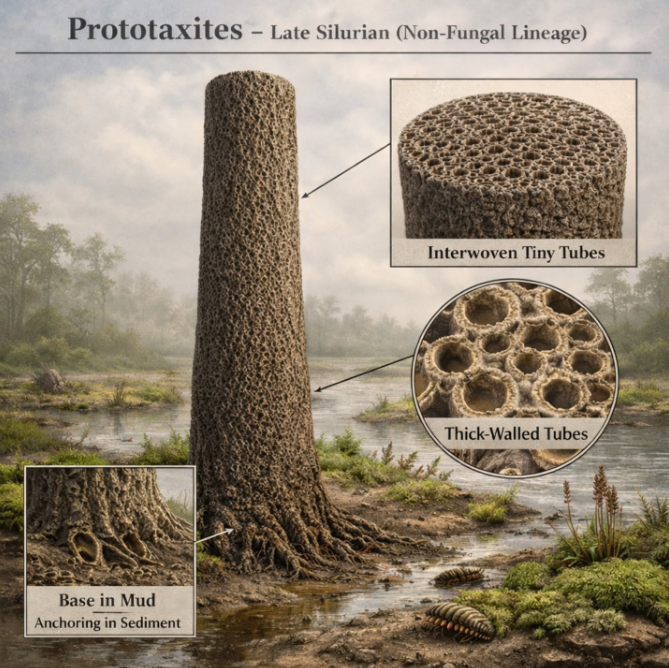
| Structure | Cylindrical trunks made of interwoven microscopic tubes |
| Possible classification | Unknown lineage of multicellular life |
More than a century and a half after its discovery, Prototaxites remains an unresolved scientific mystery. As new technologies allow researchers to examine ancient fossils in unprecedented detail, scientists hope the towering organism will eventually reveal its true identity.
Until then, Prototaxites stands as a reminder that Earth’s distant past may have hosted forms of life far stranger than anything seen today.
The Enigma of Prototaxites
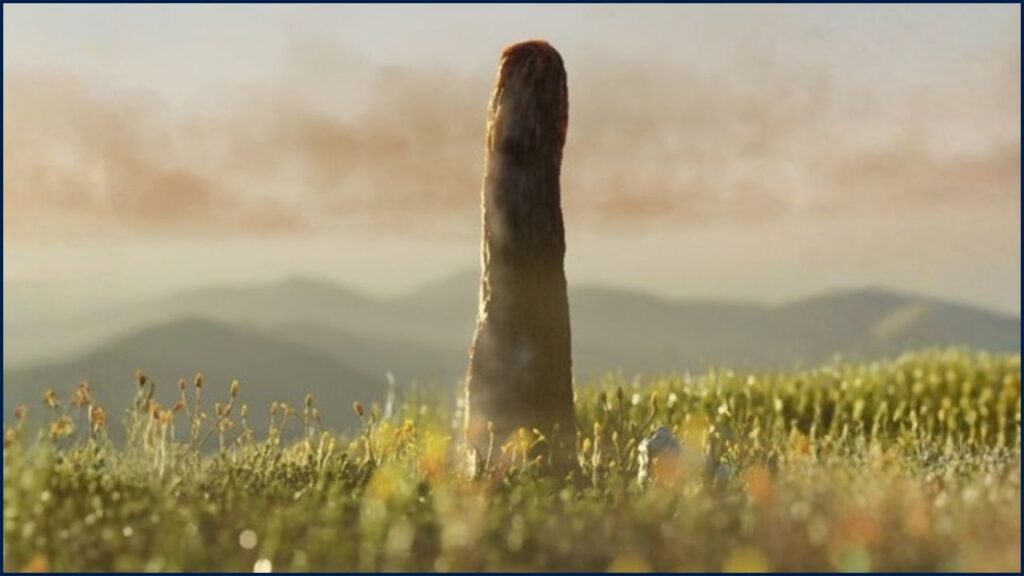
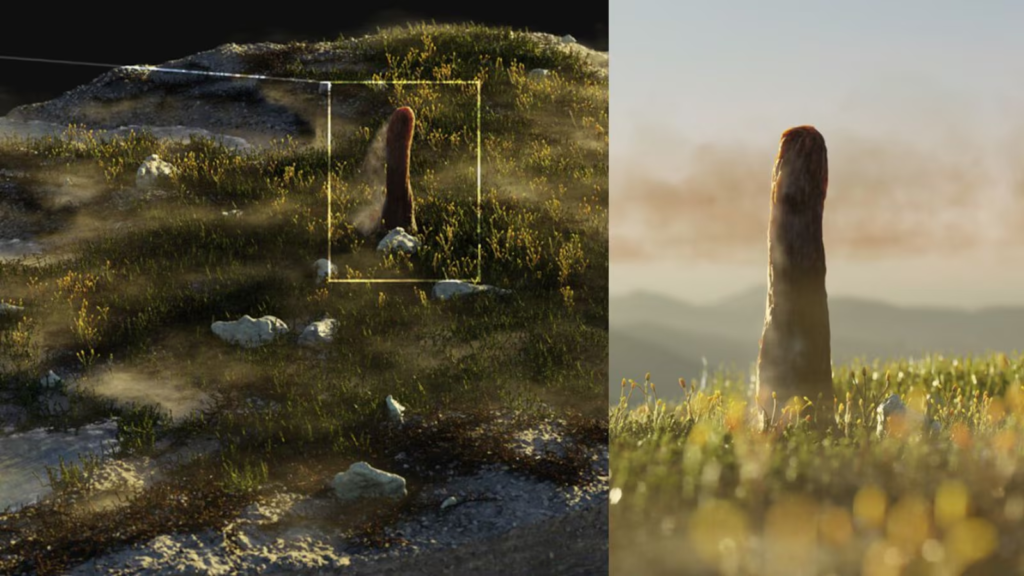
The fossils of Prototaxites resemble massive cylindrical trunks rising from the ground. Some specimens measure over one meter in diameter and reach heights comparable to a modern two-story building.
These towering structures would have stood dramatically above the surrounding vegetation. During the Devonian period, most land plants were small and simple, rarely growing taller than a few inches. In that environment, Prototaxites likely dominated the landscape, appearing as enormous pillar-like organisms scattered across early terrestrial ecosystems.
Inside the fossilized trunks, researchers have discovered complex networks of microscopic tubes woven together in intricate patterns. These structures differ from the tissues found in modern plants and animals, making classification difficult.
The unusual anatomy has fueled scientific debate for more than 180 years.
Discovery and Early Interpretations
The story of Prototaxites began in the mid-19th century when unusual fossilized structures were discovered in Canada and Europe. Early researchers struggled to understand what they were looking at.
Some scientists initially believed the fossils represented the remains of ancient trees. The name Prototaxites itself reflects this interpretation. The term loosely translates to “first yew,” referencing the possibility that the organism was an early conifer.
However, this explanation soon faced problems. The fossils lacked essential characteristics of trees, such as wood structure, leaves, or roots. Later researchers suggested that the organism might have been a type of giant algae. Others proposed that it was not a single organism at all but instead a structure formed by colonies of microorganisms. Over time, the prevailing hypothesis shifted toward a different explanation: that Prototaxites was a massive fungus.
The Giant Fungus Hypothesis
The fungal interpretation gained significant attention in the early 21st century when researchers conducted detailed microscopic studies of the fossil structures.
The internal network of tubes appeared somewhat similar to fungal filaments known as hyphae. In modern fungi, these thread-like structures form dense networks called mycelium. Some scientists argued that Prototaxites could have been a giant fungal structure, possibly similar to large mushroom-forming fungi but without recognizable caps or stems. If true, it would represent one of the largest fungi ever known.
Chemical studies also suggested that the organism obtained nutrients from organic material rather than producing energy through photosynthesis. That behavior would be consistent with fungi, which absorb nutrients from their surroundings. Yet the theory never fully resolved the mystery.
New Evidence Raises Doubts
More recent investigations have complicated the fungal interpretation. Advanced chemical analysis of well-preserved fossils revealed that the organism’s composition differs significantly from that of modern fungi.
One major surprise involved the absence of certain compounds typically found in fungal cell walls.
Researchers also noted that the structure of the fossilized tubes varied widely in size and arrangement, unlike the more uniform patterns commonly seen in fungal tissues.
These findings suggest that Prototaxites may not belong to any modern biological group.
Instead, scientists increasingly suspect that the organism represents an evolutionary lineage that has completely disappeared.
The Devonian World: Life on Land Takes Shape
To understand the significance of Prototaxites, it is important to consider the environment in which it lived.
During the early Devonian period, life was only beginning to establish itself on land. Plants had recently evolved from aquatic ancestors and were still relatively simple.
Most early land plants lacked roots, leaves, and vascular systems capable of transporting water efficiently. As a result, they remained small and close to the ground.
The landscape likely resembled a patchwork of moss-like vegetation interspersed with microbial mats.
Animals had only just begun exploring terrestrial habitats. Early arthropods such as millipede-like creatures and primitive insects crawled across the soil, while vertebrates remained primarily aquatic.
In this world of low-growing vegetation, Prototaxites stood out dramatically, rising high above the surrounding environment.
Its presence may have played an important ecological role.
Possible Ecological Roles
Because scientists still do not fully understand what Prototaxites was, its ecological role remains uncertain. However, researchers have proposed several possibilities.
One theory suggests that the organism functioned as a large decomposer, breaking down organic material in early soils. If true, it may have helped recycle nutrients in primitive terrestrial ecosystems.
Another possibility is that Prototaxites formed symbiotic relationships with microbes or small plants.
Some researchers have even speculated that the organism might have served as a structural habitat for early land animals, providing shelter or feeding opportunities.
Although these ideas remain hypothetical, they illustrate how important such organisms may have been in shaping early terrestrial ecosystems.
Why Classification Matters
The debate surrounding Prototaxites highlights an important issue in evolutionary biology: the tree of life is constantly being revised.
Modern classification divides complex life into several major groups, including animals, plants, fungi, and various microorganisms.
However, these groups represent only the lineages that survived to the present day.
Throughout Earth’s history, many evolutionary experiments may have emerged and later disappeared without leaving living descendants.
If Prototaxites represents such a lineage, it suggests that early life on land may have included major biological groups that no longer exist today.
Understanding those lost lineages could provide valuable insight into how complex life evolved.
Scientific Methods Unlocking the Mystery
Modern researchers are using increasingly sophisticated techniques to analyze fossils like Prototaxites.
High-resolution imaging allows scientists to study microscopic structures preserved within ancient rocks.
Chemical analysis can identify traces of organic compounds that remain in fossilized tissues after hundreds of millions of years.
Researchers also compare fossil structures with modern organisms using digital modeling and statistical analysis.
These tools help scientists test competing hypotheses about the organism’s identity and biology.
However, the extreme age of the fossils means that much of the original biological material has been altered by geological processes.
As a result, the evidence remains incomplete.
A Timeline of Scientific Understanding
1850s: Fossils discovered and initially interpreted as ancient tree trunks.
Late 1800s – early 1900s: Alternative theories suggest algae or microbial colonies.
2000s: Microscopic analysis supports the idea that Prototaxites may have been a giant fungus.
Recent studies: Chemical evidence challenges the fungal interpretation and raises the possibility of a previously unknown lineage of life.
This evolving timeline illustrates how scientific knowledge progresses through repeated investigation and debate.
Implications for the Evolution of Life
The mystery of Prototaxites extends beyond a single fossil species. It raises broader questions about the history of life on Earth.
Early terrestrial ecosystems may have been populated by organisms unlike anything that exists today.
Some evolutionary branches flourished for millions of years before disappearing entirely, leaving only fragmentary fossil evidence.
Studying these organisms helps scientists reconstruct the processes that shaped modern biodiversity.
It also highlights the complexity of evolution during periods when life was experimenting with new forms and ecological strategies.
What Scientists Hope to Learn Next
Researchers continue to search for additional fossils and better-preserved specimens that could reveal new clues about Prototaxites.
Future studies may examine fossil chemistry in greater detail or apply new imaging techniques capable of identifying microscopic biological structures.
Some scientists also hope to find related organisms that could help place Prototaxites within a broader evolutionary framework.
For now, the organism remains one of the most puzzling fossils ever discovered.
FAQs About Mysterious Giant Organisms That Challenge Life Classifications
What was Prototaxites?
Prototaxites was a giant trunk-like organism that lived during the Devonian period more than 400 million years ago.
Why is Prototaxites difficult to classify?
Its fossil structure and chemical composition do not clearly match those of plants, fungi, algae, or animals.
How large was Prototaxites?
Some specimens reached approximately 8 meters (26 feet) in height, making it one of the tallest organisms in early terrestrial ecosystems.
Where have Prototaxites fossils been found?
Fossils have been discovered in several regions, including parts of North America and Europe.