
Farmers today are dealing with a new kind of uncertainty. Rainfall patterns are shifting, fertilizer prices rise without warning, and heat waves now last longer than they used to. At the same time, energy demand keeps climbing everywhere.
That’s why solar panel farming is attracting serious attention across agricultural regions. Instead of forcing farmers to choose between growing food or producing clean power, solar panel farming allows both to happen on the same piece of land. Recent field research conducted on working farms shows this approach is more than a theory. It’s already changing how land is used. Some farmers reported lower water use and more predictable income. Others noticed crops reacting differently under partial shade. The biggest takeaway is simple. Solar installations are not automatically harmful to agriculture. With proper planning, they can actually support farm productivity while adding a reliable revenue stream.
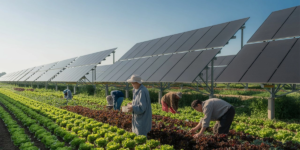
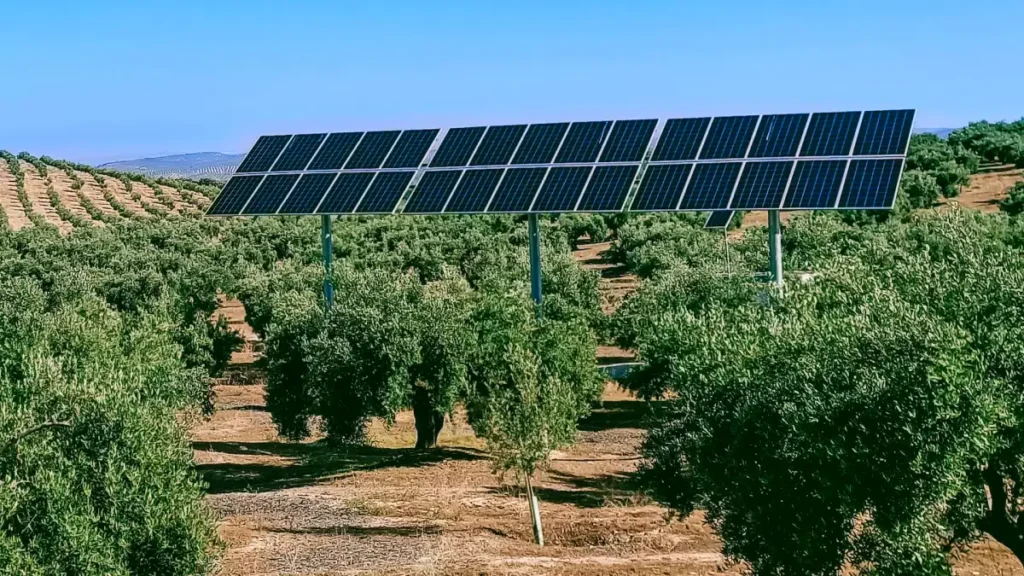
Solar panel farming, often called agrivoltaics, combines agriculture and solar electricity generation in one coordinated system. Instead of placing panels close to the ground like traditional solar projects, structures are raised higher and spaced wider so sunlight can still reach the soil. Crops grow underneath and between panel rows while electricity is produced overhead. The study found the system works best when farmers actively design crop selection and field layout around the panels rather than treating them as obstacles. The land becomes multifunctional. A single acre produces food, power, and sometimes even grazing space. Solar panel farming is quickly moving from experimental trials to real agricultural practice, especially in regions facing water shortages and rising energy costs.
Table of Contents
Solar Panel Farming
| Factor | Study Observation | Practical Impact |
|---|---|---|
| Crop Yield | 5 to 15 percent reduction for some crops, up to 20 percent increase for others | Crop selection becomes important |
| Irrigation Needs | 10 to 30 percent less water required | Reduced irrigation costs |
| Soil Temperature | Cooler during hot afternoons | Healthier root systems |
| Installation Cost | Higher upfront investment | Financing often required |
| Energy Revenue | Steady monthly electricity income | Financial stability |
| Field Operations | Machinery movement adjusted | New planting layouts |
| Climate Response | Best results in hot dry climates | Climate adaptation tool |
The research makes one thing clear. Solar panel farming does not replace agriculture. It reshapes it. Crop yields vary depending on plant type, but water savings, soil protection, and reliable income offer meaningful advantages. For farmers facing unpredictable weather and rising costs, diversification is essential. Solar panel farming provides exactly that. The land continues producing food while also generating clean energy. Instead of competing uses, the two functions support each other. In a future where food security and renewable power are equally important, combining them on the same land may become not just innovative, but necessary.
Why Farmers Are Considering Solar Panels
- Farmers have always relied on variables they cannot control. Weather, market prices, pests, and transportation costs all affect yearly income. Solar panel farming introduces something agriculture rarely has had predictable earnings.
- Electricity production provides steady payments. Even during a poor harvest season, the solar array still generates power daily. Many farmers say this reduces financial stress. Instead of depending entirely on crop sales, they now have a second reliable income source.
- Another important factor is land preservation. Agricultural land is often sold for housing or commercial development because it offers better returns. Solar panel farming allows landowners to keep their farms active while increasing revenue potential. The land remains agricultural rather than permanently converted into buildings.
- Energy independence also matters. Rural areas frequently experience unstable electricity supply. Local solar generation improves reliability and can reduce long-term energy costs for surrounding communities.
How Shade Changes Crop Growth
The first reaction many people have is concern that solar panels block sunlight and hurt plants. The research shows the reality is more nuanced. Plants need sufficient sunlight, not maximum sunlight. During extreme summer heat, too much direct sun damages leaves and slows photosynthesis. Solar panels create filtered light. Instead of harsh afternoon radiation, crops receive diffused illumination. Leafy vegetables often benefit the most. Lettuce, spinach, and herbs grow with fewer burned leaves and maintain moisture longer. Tomatoes and peppers typically produce steady harvests, though they may mature slightly later. On the other hand, full-sun grains like wheat can experience modest yield reductions. Farmers quickly learn to match crops with shade patterns. Rows receiving more direct light are planted with fruiting crops. More shaded sections support greens or forage plants. Solar panel farming therefore changes crop planning rather than eliminating crop production.
Water Savings and Soil Health
- Water conservation is one of the strongest practical benefits. Shade from solar panels slows evaporation from soil surfaces. Moisture remains longer after irrigation or rainfall. This matters especially in dry climates where irrigation costs are high. Pumps require energy, and water availability is becoming a serious concern in many farming regions. By reducing evaporation, solar panel farming lowers water demand and operational expenses.
- Soil temperature also plays a major role. During hot afternoons, exposed soil can overheat and stress plant roots. Beneath panels, soil stays several degrees cooler. Cooler soil supports microbial life that breaks down organic matter and releases nutrients. Healthier soil means improved long-term productivity. Instead of degrading land, the system may actually help protect it.
The Cost Equation
- The largest obstacle is installation expense. Elevated solar structures require stronger supports and wider spacing than standard solar projects. Farmers usually cannot finance the project alone.
- However, the financial picture changes when energy production is considered. Solar panel farming creates two income streams: agricultural harvest and electricity sales.
- Electricity payments are predictable because power production follows daily sunlight patterns. Crops vary year to year, but solar output remains consistent. Over time, this stability can balance poor harvest seasons.
- Many regions now offer incentives, renewable energy credits, or cooperative partnerships with utility companies. These programs shorten the payback period and make adoption more realistic.
Changes In Farm Operations
Operating a farm with solar arrays requires adjustments. Tractors must navigate between rows, irrigation lines are rerouted, and harvesting paths are carefully planned. Planting schedules may shift slightly because shaded soil warms more slowly in spring mornings. Weed patterns also change. Some weeds decline due to reduced sunlight while shade-tolerant weeds appear more frequently. At first, these changes feel complicated. After a season or two, most farmers say they become routine. Instead of interfering with operations, the panels become another permanent feature of the farm landscape, much like irrigation equipment or fencing.
Environmental And Community Benefits
- Solar panel farming reduces conflict between renewable energy development and food production. Traditionally, large solar farms required removing agricultural land from cultivation. This dual-use approach avoids that problem.
- There are ecological advantages as well. Panel rows create protected microhabitats where pollinator plants can grow. Many farms now plant flowering species beneath arrays to support bees and beneficial insects. This improves pollination in nearby crops and enhances biodiversity.
- Communities also benefit from local power generation. Electricity produced near consumption points improves grid reliability and reduces transmission losses.
Policy And Future Outlook
Government policies are slowly adapting to this hybrid model. Some regions now officially classify agrivoltaic land as agricultural rather than industrial. This allows farmers to maintain agricultural tax benefits and land protections. Research continues to improve system design. Engineers are experimenting with adjustable panel angles and automated tracking that balances plant needs with energy output. Future solar panel farming systems may be designed specifically for agriculture instead of adapting traditional solar farms. With climate variability increasing and farmland under pressure, this approach is expected to expand rapidly over the next decade.
FAQs About Solar Panel Farming
1. Does solar panel farming harm crops
No. Some crops show small reductions while shade-tolerant crops often improve in quality and consistency.
2. Which crops grow best under solar panels
Leafy vegetables, herbs, and certain forage crops perform especially well because they benefit from cooler conditions.
3. Is solar panel farming profitable
Yes. While installation costs are high initially, stable electricity income often balances farm revenue over time.
4. Can farm machinery still operate in these fields
Yes. Panels are installed high enough for tractors and equipment, though the field layout must be planned carefully.